The Ableism of Western Masculinity

When I, and others, read definitions of what it means to be “masculine” in the western world, we get words like: active, aggressive, ambitious, analytical, assertive, athletic, authoritative, blunt, certain, competitive, decisive, dominant, forceful, independent, individualistic, physical, protective, self-reliant, self-sufficient, strong and tough.

Some of these meanings of masculinity are perfectly okay—being active, ambitious, analytical and certain, for example, can be positive traits in many circumstances.

Other traits are, in my humble opinion, traits that contribute to gender inequality and so many sexual assaults against mostly women—being aggressive, authoritative, dominant, and forceful come to mind. The topic of how some ideas of western masculinity contribute to gender inequality and sexual violence may very well be the subject for a future post, but I won’t cover this in my current one.

And then there are other “masculine” traits such as: active, athletic, independent, physical, self-reliant, self-sufficient, strong, and tough. These traits are ableist, or discriminating in favor of able-bodied people, at least to some extent, because men who have disabilities are then viewed as completely unable to fit these traits of what it apparently means to be a “true man” or “manly enough.”

Consider the following:

  1. If you are a blind person, you don’t fit into some people’s ideas what it means to be masculine. The definition of masculinity includes independence, self-reliance, and self-sufficiency, yet you need to depend on other people, animals or things to guide you.
  2. If you are deaf person, you don’t fit into what some think it means to be masculine. You need to depend on sign language from others or closed caption coming from a machine, so you therefore don’t have the independence, self-reliance, or self-sufficiency associated with masculinity.
  3. If you need a cane to get around (let alone if you’re in a wheelchair), you don’t fit into our society’s idea of what it means to be masculine. Regardless of what your level of activity is (and I know my share of people who are on a cane or in a wheelchair AND are actually quite athletic), you are often viewed as inactive, unathletic, dependent on others and weak if you use a cane or are in a wheelchair.

The bottom line is that if you are a man with some form of disability, that person likely does not fit the definition of masculinity. In fact, because masculinity is ableist, the very ideas associated with modern western masculinity completely exclude men with disabilities the “manliness club.”

So when I hear someone talk about “toxic masculinity,” I agree—masculinity is toxic. The ableism of masculinity makes masculinity inherently toxic.

Note: I want to thank the blog Me, Myself and Disability for bringing this issue to my attention. When I first discovered that blog, I read a post about the author’s own experiences with the ableism of masculinity. If you want to get a more personal perspective on the ableism of western masculinity, I highly recommend that you read his post on the issue.
Summer 2018 Blog News!

I hope everyone is having a good start to summer! I certainly am.

As we head into the summer, there are a few big pieces of news I want to share.

First, I have been featured in two blogs! Yes, you read that correctly, I have been in TWO blogs since I last did a blog news post! Back in late May, I wrote about my blog on What You Blog About. It was a great opportunity for me to share my blog with people who might not be aware that my blog exists. Please check out my post on this blog! Then in July, Bookmark Chronicles had a nice interview with me about my blog, and about me, personally.

Second, I am also going to somewhat expand from the original focus of my blog. As my readers probably know by now, the main purpose of my blog has been to discuss injustices that we may be blind to and/or blindly commit. However, after much thought, I’ve decided that I will also occasionally make posts about just actions (or forms of just actions) that people may not realize and/or blindly commit. I will explain further in next Friday’s post, and share some of my plans with this idea!

Finally, remember that I will not post on Tuesday, September 4th (the day after Labor Day.

Lacking Recycling Bins in Public Spaces: A Waste of an Opportunity

IMG_20180811_111536
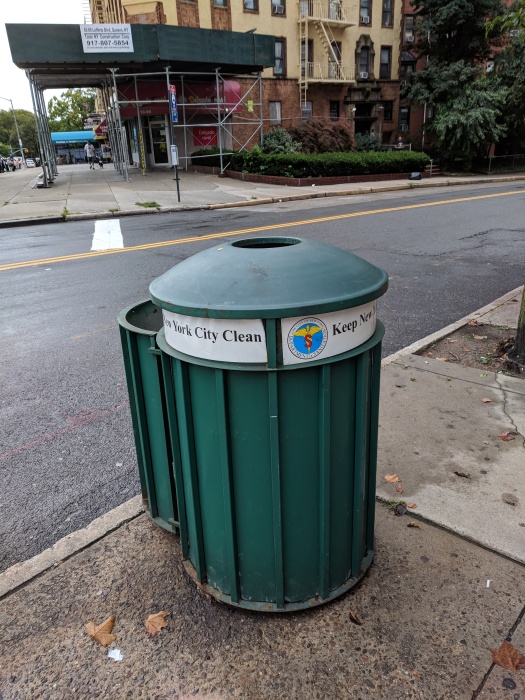
This is a photo of one of many areas in New York City that has a trash can, but no recycling cans. This photo was taken by me. 

When I saw a good friend in Philadelphia the other day, I had an environmental brain cramp. Namely, I didn’t think to hold my plastic water bottle until I got to my friend’s house, and I therefore put the bottle in a public trash bin.

Now, I am at fault for not waiting until I got to my friend’s house, where I could’ve actually recycled the bottle. However, the City of Philadelphia was also at fault for not having a recycling bin for plastic in a public space.

The thing, though, is that the problem I describe is not unique to Philadelphia. It is a widespread problem throughout the United States in places ranging from Carlisle, Pennsylvania (the town where I went to college) to my hometown of New York City.

I don’t understand why recycling bins are still uncommon in so many places. It’s not like there’s a lack of knowledge about the benefits of increasing the amount that our society recycles. Or that there’s a lack of desire to increase how much we recycle because many of these places without adequate public recycling have been led by environmentalists for many years.[1] I just don’t know why there hasn’t been more of a conscious effort to have more recycling bins in public spaces. My only explanation is that this issue has been overlooked, though if anyone else knows why, please leave a comment below.

What I do know is that we’re wasting an opportunity to increase recycling by not having more recycling bins in public spaces, because while I don’t think that recycling in public spaces will, by itself, save this planet, what will help is measures that help our society be better stewards of the environment, including the providing of recycling bins in public spaces.


[1] Michael Bloomberg won three terms as New York City Mayor as a Republican, but the original pilot program for recycling in parks and transit hubs in New York City started in 2007, during his second term as mayor.

Shared Post-Playing Along: How Sexual Harassment Pays My Wages

Yet again, I came across a piece so good that I must share it!

The post I’m sharing this week is a from Sarah, who actually goes to the same college I graduated from! In her post, she discusses how a friendly and flirtatious approach to sexual harassment results in the author (and probably many other waitresses) earning much more money than a stern approach.

The implications of Sarah’s findings (at least from my perspective) are that:

  1. Sexual harassment plays a disturbingly major role in the jobs (and paychecks) of many waitresses.
  2. The way we pay tipped workers in the United States needs to change drastically. I’ve already advocated for this in a post last April on my blog, but I think Sarah’s post only strengthens that argument.
  3. We need to do a whole lot better as a society at treating tipped staff with the respect and dignity they deserve. Too many of us treat our tipped staff like garbage and that needs to stop.

Here’s the link to Sarah’s post.

Institutional Racism Series: A Conclusion

While I was working on a post to conclude this series on institutional racism, I did a Google search of “institutional racism polls” (mostly to get a sense of seeing how many Americans believe in the existence of institutional racism). The first two results for this search showed commentator Ben Stein saying that there is no more institutional racism in America.

It’s ironic that the first two results for this search show Ben Stein denying the existence of institutional racism because, actually, I think that my series of posts on the subject shows the opposite. The series demonstrates that institutional racism exists, even in 2018.

This institutional racism exists in housing systems, school systems, policing institutions, and colleges. It exists in many other institutions that I did not mention in my blog series. It exists in so many places that someone could quite possibly run a whole blog on the subject of institutional racism.

So if you ever question the existence of institutional racism, or run into someone who questions or doubts the existence of institutional racism, I hope that people can look at the posts in my series and say: “Wait…institutional racism exists, in America, in the 21st century.” After all, it’s difficult to fix racism as a whole without realizing the existence of institutional racism.

Note: While this is my last post in my series on institutional racism, it’s possible (maybe likely) that I will still make some individual posts related to institutional racism.

Previous blog posts from my series on institutional racism:
“Introduction”
“Institutional Racism Series: How it Affected Where I Live”
“Institutional Racism Series: How it Affected Where I Went to School”
“Institutional Racism Series: How it Affected How I, and Others, Were Policed”
“Institutional Racism Series: How it Affects College Experiences”