Introducing a New Series of Blog Posts!

A few months ago, when my dad was looking over a draft of my post on the racist writings on my family’s car and in my neighborhood, he said something along the lines of, “This post is fine, but one thing you haven’t addressed on your blog is institutional racism.”

He was right. I haven’t addressed that topic yet. It’s also a topic that’s important to address, in large part because institutional racism is often ignored or denied.

But what is institutional racism, and how do I plan to address this topic?

Most definitions, including mine, would describe institutional racism as racism that is practiced and sometimes even normalized by social, economic, governmental, and other institutions. Institutional racism could be subtle or overt, but one reason why I think many people deny the existence of institutional racism is because it is often so subtle.

My blog post series hopes to show that institutional racism exists, and that it exists in so many areas of our daily lives. I hope to do this through a series of four posts over the next few months: one on how it affected where my family lives, one on how it changed where my brother and I went to school, one on how it affected how I was policed (especially compared to most people in the majority-minority neighborhood I’m in), and one on how it affected my college experience.

I believe in making the case for the existence of institutional racism through parts of my own experiences because I believe that my stories, and the larger factors that play into my stories, are a few examples of the institutional racism I frequently hear about.

While institutional racism has affected me, I emphasize that, by-in-large, the institutional racism has been to my advantage as a white person, and to the disadvantage of people who are not white or are not labeled as white.

Some of my readers may already be on board with the idea that institutional racism exists, and some of my readers may even be able to cite personal examples of institutional racism helping or hurting themselves (or people they care about). However, I also hope that people who are skeptical of, or deny, the existence of institutional racism can see through my personal experiences that it does exist in the 21st century, in the United States of America.
Racism Exists Where You Don’t Expect It

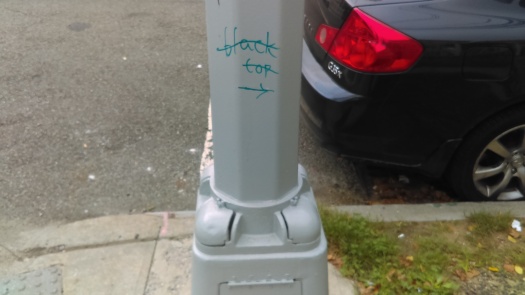
A few weeks ago, someone (I don’t know who) wrote some extremely disturbing things on my family’s car and on street poles near my family’s house. The person wrote things like “n****r,” “Mexican n****r,” “black cop,” and “Black people are stupid.”

I was tempted to not say anything, anywhere, about all of this. I decided otherwise.

I will use my experience with such hateful rhetoric by saying this: racism exists where you don’t expect it.

People tend to associate racism with certain parts of the country, or even with certain parts of states. I’ve heard people from the northern United States make remarks about the “racist South.” I’ve heard people from northern New Jersey make remarks about how southern New Jersey is a hotbed for racists. I’ve heard people in New York City remark about how upstate New York has many racists. And, admittedly, I’ve been behind some of those remarks and/or have implicitly or explicitly agreed with many of those remarks.

But the thing is that I don’t live in southern New Jersey, upstate New York, or the southern United States. I live in New York City. People often don’t think of New York City as a hotbed for racists. Yet, I was staring at racism in my New York City neighborhood several weeks ago, both figuratively and literally.

The bottom line is this: racism exists in places where you don’t expect it. It exists everywhere. You don’t just see racism in southern Jersey; it exists in northern Jersey. It doesn’t just exist in upstate New York; it exists in New York City. It doesn’t just exist in states that used to be parts of the Confederacy; it exists in states that used to be part of the Union. If there is one thing about racism that doesn’t discriminate, it is in the places where racism actually exists.

So I hope that all of us stop trying to pretend that race issues are either from a bygone era or are in part of the country that is far away from where some of us live. Wherever people exist, racists exist. I just hope it doesn’t take seeing words like “n****r,” “Mexican n****r,” “black cop,” and “Black people are stupid” in your neighborhood to recognize that fact.

IMAG0538
This racist language was not found in Alabama or even southern New Jersey, but in my own neighborhood in New York City. This photo was taken by me.

Addressing Colin Kaepernick

I am going to start this post by doing something unusual—comparing the career and season statistics of two National Football League (NFL) quarterbacks. No worries, though, because this comparison serves a greater purpose…

Quarterback #1’s career statistics: Completion percentage of 58.4, 1.74 touchdowns for every interception he’s thrown, 86.1 quarterback rating.

Quarterback #2’s career statistics: Completion percentage of 59.8, 2.4 touchdowns for every interception he’s thrown, 88.9 quarterback rating.

Quarterback #1’s 2016 statistics: Completion percentage of 52.9, 1.36 touchdowns for every interception he threw, 75.8 quarterback rating.

Quarterback #2’s 2016 statistics: Completion percentage of 59.2, 4 touchdowns for every interception he threw, 90.7 quarterback rating.

Quarterback #1 is Cam Newton, who had a down year last year but was the 2015 Offensive MVP and is still viewed as one of the bright young stars of the NFL. Quarterback #2 is Colin Kaepernick, who is currently not on an NFL roster.

While I am sure other football fans can find statistics where Newton compares favorably to Kaepernick, the point of this comparison is not to say whether Cam Newton or Colin Kaepernick is a better quarterback. But the mere fact that the unemployed Kaepernick has statistics even comparable to a former NFL Offensive MVP should tell people one thing about the current state of Kaepernick’s career: his unemployment has nothing to do with football, and everything to do with the fact that many of us (myself included, at times) resent athletes who challenge our society’s status quo.

The most recent example of this is with Kaepernick. The former San Francisco 49ers player refused to stand for “The Star-Spangled Banner” last year, and is not on an NFL roster this year thus far.

However, this is far from the first time that an athlete faced severe consequences for challenging the societal status quo. Muhammad Ali, who was almost universally praised after his death last year, was reviled by many for his refusal to serve in Vietnam and his outspokenness on racial issues. Tommie Smith and John Carlos were forced to return the medals they won in the 1968 Olympics because of their Black Power salutes in a medal ceremony while “The Star-Spangled Banner” was played. And a big stir was made when Magic Johnson came out as being HIV-positive at a time when HIV/AIDS was still stigmatized, only to play in the 1992 National Basketball Association (NBA) All-Star Game and the 1992 Olympics.

If one were to consider Kaepernick, not as an isolated incident, but within the greater history of activist athletes, the conclusion is that there is a resentment toward athletes who challenge the status quo. Such resentment has stayed strong, even though decades have changed.

To those who feel that resentment, I urge all of you to at least hear out Kaepernick, even if you don’t agree with him (myself included, as I didn’t agree with his not voting in 2016). I urge everyone to hear him out because, when athletes double up as activists, it is often for good reason and often produces positive results for our society. For example, Muhammad Ali’s outspokenness on racial issues positively contributed to the Civil Rights Movement, and Magic Johnson’s openness on testing HIV-positive started to remove the stigma surrounding HIV/AIDS. It remains to be seen whether Kaepernick will make contributions as positive as those of people like Johnson and Ali, but given the fact that positive things can and often do happen when athletes double up as activists challenging the status quo, we should at least give him a chance.

Kaepernick
Colin Kaepernick. By Mike Morbeck (Flickr: Colin Kaepernick) [CC BY-SA 2.0 (http://creativecommons.org/licenses/by-sa/2.0)%5D, via Wikimedia Commons.  https://commons.wikimedia.org/wiki/File:Colin_Kaepernick_-_San_Francisco_vs_Green_Bay_2012.jpg


The Problems with “Racial Colorblindness”

Maybe there is an irony that my first serious post with “Blind Injustice” has the word “colorblind” in the title.

Though when we think about what it means to be racially colorblind, and how racial colorblindness is an oft-discussed topic, maybe it shouldn’t come as a surprise.

Colorblind ideology seems good to some, on the surface. It was an especially appealing idea to me a few years ago because it seemed to reflect the idea that, if we ignore racial differences, we would no longer treat people with other skin colors differently.

However, through friends, life experiences, and reading over the past few years, I noticed some problems with racial colorblindness that all of us should be aware of:

  1. Being colorblind means that we are blind to how people are created. People are created with various skin colors, and denying that through racial colorblindness does not seem like a way of acknowledging, let alone giving glory to, the way each of us were created.
  2. If we take pride in colorblindness, then we will not be taking pride in the diversity of ways we were all created. It is pretty awesome that the skin of human beings was created in so many different ways! Through racial colorblindness, we would not appreciate the diversity of ways in which we were created.
  3. Colorblindness means that we don’t see ourselves and others for who we are. Skin color is a part of who every one of us is, so saying that we don’t see color means that we don’t see ourselves and others for who we are. In other words, the phrase of “I don’t see color…I just see people” is not really accurate because by not seeing color, we’re not seeing the complete person. Such views can actually be hurtful to ourselves and others, even if our intentions were ones of nondiscrimination.
  4. Colorblindness also means that we are blind to how skin color has a factor in what happens around us. In particular, colorblindness can help us ignore the critical role that skin color plays in injustices such as police brutality, housing, economic inequality, inequality of public services, and more. Consequently, colorblindness keeps us from getting to the root of many problems, let alone solving the problems (and in the process keeping forms of racial injustice alive and well).
  5. Colorblindness also blinds us to the ways that we might discriminate against people with different skin colors. I know this point goes contrary to the thinking that being blind to skin color is the way to treat all people equally. I also know that this point will lead people to the “But I’m not racist!” reaction. However, the messy truth is that if we remove our own defensiveness and colorblindness, maybe we’d find ways that skin color plays a role in how some of us might contribute to school segregation (yes, modern-day school segregation exists), housing inequality, financial inequality, racial stereotypes, or some other form of racial injustice.

This is admittedly not a perfect or complete list. However, this list shows how colorblindness takes away from the beauties of having different skin colors, and at the same time fails to acknowledge the role that skin color plays in the challenges we face.

By removing colorblindness, we can appreciate people for how we were created, hopefully embrace the diversity of ways we were created, and recognize the problems that exist because people with different skin color are still treated in different ways. This removal of colorblindness may not solve all our problems with racial injustice, but hopefully it can at least make us aware of the root of racial problems.