Coronavirus Update From New York City: May 6, 2021

Today’s COVID update post is somewhat less exciting than last week’s update post, for I do not have a vaccine (or its side effects) to report on. That being said, I am a few days away from having the maximum immunity built up (I took my second dose a week and a half ago), so having full immunity will be exciting.

There has been much talk about what someone can do if they are fully vaccinated. Given all the discussion on what a fully vaccinated person can do (or should do), and what a fully vaccinated person should still be cautious with, I’m going to get involved in that discussion by talking about how I plan to conduct myself once I am at maximum immunity starting in a few days. The goal of talking about how I plan to conduct myself once I have that immunity built up is to hopefully get others thinking about how they want to move forward when they are fully vaccinated.

How I plan to conduct myself, in terms of the activities I am willing to do, will depend on answers to several questions:

  1. What COVID-19 variants are around? Furthermore, are said variants deadly? And if said variants are deadly, how well do my Moderna shots protect me from getting those variants? If there are deadly variants around, I want to be sure that my Moderna shots protect me from getting said deadly variants. If I’m not sure whether the Moderna keeps me from contracting a deadly variant going around, then I would still act with some level of caution. To use a relevant example, unless there is information I have missed, there’s still more to learn about how well the vaccine responds to the deadly Indian variant, so I will want to act with a bit of caution (especially when it comes to the riskiest activities from a COVID standpoint, such as dining indoors and being in crowds indoors). According to Dr. Anthony Fauci, Director of the U.S. National Institute of Allergy and Infectious Diseases, the Covaxin vaccine that’s being used in India is preliminarily showing promise against this variant,[1] but alas, the vaccine shot I got was not Covaxin but Moderna. One note I should add is that if we’re in a place where none of the variants are deadly and/or the Moderna vaccine is known to be effective against the most serious variants that are around, then I would be willing to engage in even the riskier activities (though I imagine there will be a mental barrier to get through on the first occasion that I, say, dine indoors for the first time since pre-COVID).
  2. How much community spread is there of the virus where I live, and how much community spread is there where I want to go? Even if I’m unsure how well my Moderna shot works against certain variants, if community spread of COVID-19 is pretty low, then I would feel safe with a wider variety of activities than if community spread were pretty high. In my case, I live in a county (Queens County) where the rate of infection is below 1.0,[2] which in layperson’s terms means that at the rate we’re going, we’re going at a rate to slow and hopefully eventually stop the spread of the disease.[3] As such, I might be willing to do somewhat more in terms of activities (especially given that I’m fully vaccinated) than I would even if I were vaccinated and community spread (particularly spread of variants with unknown effectiveness with the Moderna) were widespread.
  3. If we don’t know whether my Moderna shots react to a deadly variant going around, is the activity I’m thinking of an activity that’s relatively safe even if I were unvaccinated? We have a fair bit of data of which activities are safe or unsafe for even unvaccinated people, and the results may be surprising. For all that public transport has a reputation for being a germ factory, for example, there is no correlation found between riding subways and COVID-19 spread.[4] On the other hand, if you are indoors in a place with poor ventilation, having six feet of distance between yourself and someone else may not be enough.[5]

Before wrapping up my post, I should also note that the United States Centers for Disease Control and Prevention (CDC) has its own chart on which activities are and are not safe for both fully vaccinated people and unvaccinated people.[6] My approach to COVID as a fully vaccinated person seems to be a little more cautious than what the CDC’s guidance lays out currently, but at the same time, the CDC’s guidance is worth noting because as I have said to my parents on multiple occasions, following their guidance has helped me get this far without catching COVID.

While I don’t know how much (if at all) my readers will agree with my guiding principles for what activities I do, post-vaccination, I hope that at least this post will get other people thinking about what they do after getting vaccinated. Overall, getting the vaccine is worth it to me because it protects us against so many troublesome variants, but I plan on acting with caution with certain activities until we learn more about how the Moderna vaccine responds against other troublesome variants; notably, the Indian variant.


[1] https://www.whitehouse.gov/briefing-room/press-briefings/2021/04/27/press-briefing-by-white-house-covid-19-response-team-and-public-health-officials-32/

[2] https://covidestim.org/us/NY/36081

[3] You may’ve heard that in certain places, the rate of infection is “below 1.0” or “above 1.0.” Here, you can find an explanation of what these numbers mean: https://www.yalemedicine.org/news/12-best-covid-19-prevention-strategies

[4] https://gothamist.com/news/new-study-finds-no-direct-link-between-subway-covid-19-spread

[5] https://www.nbcnews.com/health/health-news/6-feet-may-not-always-be-enough-distance-protect-covid-n1238083

[6] https://www.cdc.gov/coronavirus/2019-ncov/daily-life-coping/participate-in-activities.html
Coronavirus Update From New York City: April 29, 2021 (Second Vaccine Shot Edition)

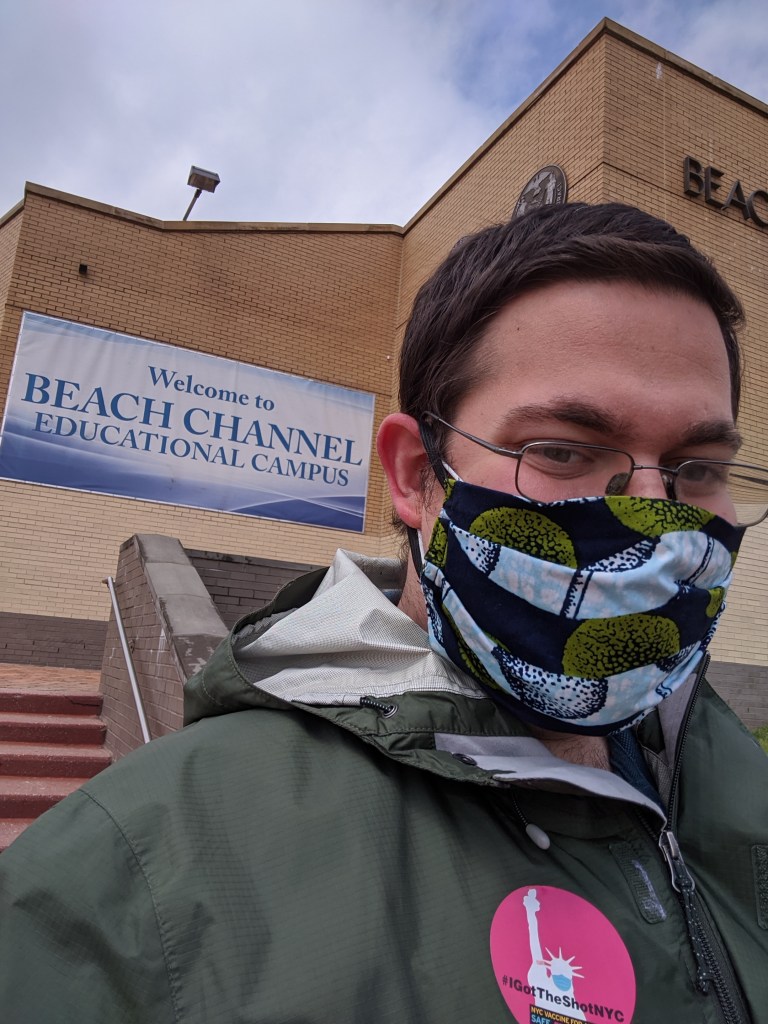
A picture of me after I got my second Moderna COVID-19 vaccine shot

As readers can tell by the title of tonight’s COVID update blog post, I have now received my second and final shot of the Moderna COVID-19 vaccine!

I got the shot last Sunday, April 25th.

The directions for heading into the facility for my second shot could’ve been better, as a number of us were confused as to where exactly we should be going. However, once I got into the facility that was doing the vaccinations, it was a pretty quick and smooth process to get from check-ins to the vaccination, and from the vaccination to post-vaccination monitoring.

As for side effects, they were more severe after the second dose than after the first dose–something which is apparently the case for many people. After my first dose, I just had a sore arm for a short period of time. After my second dose, I started with a sore arm. However, on the night after I received my vaccine shot (night of the 25th/morning of the 26th), I woke up to my shivering. I had chills. In addition to chills and the sore arm, I ultimately had the following side effects:

  • Headache
  • Fatigue
  • Reduced appetite (which for me often comes with having fatigue and/or a headache, so it’s hard for me to say whether this was an actual side effect or the result of other side effects)
  • Fever (at one point, a fever of 100.5)

Such side effects are apparently not unusual, for many people report having low-grade COVID symptoms after their second vaccine dose (with both Pfizer and Moderna) for anywhere between one day and few days. In my case, the most severe side effects lasted for 24 hours (with only a little bit of arm soreness after I recovered from other side effects). However, each person’s body is different, and as such, each person’s reaction to their second vaccine dose is going to be different. Regardless, if you feel unwell for a day or two or even three, don’t panic. If you still feel unwell even after a few days have passed, I would recommend calling a doctor.

Obviously, in terms of side effects, you want to hope for the best. Still, if you want to “prepare for the worst” (which is nothing compared to actually having COVID), those who are taking their second vaccine doses should be prepared to:

  • Potentially feel unwell for somewhere between one day and a few days
  • Drink lots of water if you feel unwell (a special shoutout to the friends of mine who told me the same thing)
  • Rely on the help of others for a day to a few days (or, if you have nobody else to rely on, prepared to not do much for a day to a few days if at all possible)
  • Use sick leave at work, if your job has such a thing as sick leave

For all that I’ve talked about my side effects from the second Moderna shot in this post, I should emphasize that I have zero regrets about getting the second shot. If I had to make the same decision all over again about whether to get a second shot, I would get my second shot without the slightest bit of hesitation. Likewise, I would urge others to not be hesitant about getting that second shot, even with stories of side effects from people like me. For one thing, the science says that you need both vaccine shots of the Pfizer and Moderna in order to have maximum protection, so while some are foregoing their second shots because they believe they have adequate protection from COVID, the science simply does not match up with that belief.[1] For another thing, while one can experience side effects from the second vaccine shot, the side effects are child’s play compared to actually getting symptoms of the virus–a virus that has killed nearly 3.2 million people worldwide as of the time of my writing this post. As such, I beg those who are hesitant about having a second vaccine dose to keep things in perspective, and remember that having COVID (or putting yourself at risk for having COVID through not being fully vaccinated) is much riskier than having a COVID vaccine (even the Johnson & Johnson vaccine, which is a single-shot vaccine and has had blood clot issues reported with a tiny number of vaccine recipients).

I know that my paragraph above was rather lengthy, but given that apparently close to 8% of people in America who’ve received their first shots of the Pfizer and Moderna not receiving their second doses, I want to do my part in addressing the hesitancy that seems to exist with regards to getting a second shot (a lot of which seems to center around concerns about side effects as well as the belief one is protected). A lot of the talk around vaccine hesitancy is centered around getting a shot to begin with, but there’s also hesitancy around getting a second shot–hesitancy that I think those of us who have received our second shots have a moral obligation to address as best as possible.

If other readers have received their second shots of the Pfizer or Moderna, or received their single-dose Johnson & Johnson vaccine, please let me know if there’s anything to add beyond what I covered in this post!


[1] https://nymag.com/intelligencer/2021/04/millions-of-americans-are-skipping-their-second-covid-shot.html

Coronavirus Update From New York City: April 22, 2021

I hope everyone is healthy and safe, regardless of where you live.

I am on the verge of being fully vaccinated! I am scheduled to get my second dose next Sunday. I look forward to being fully vaccinated, even if there are certain public health precautions I should follow even after vaccination. Next week, I will make sure to give a full report of how the second dose went and how I felt after the shot.

Thankfully I have not heard of any other deaths of friends of friends, friends of family, colleagues of family, etc. in the past week, so that is nice for a change. I know that a couple of my COVID update posts recently have been on the sorrowful side, so it’s nice not to have tonight’s post be on the sorrowful side as well.

In other positive news, the hospital closest to where I live is under somewhat less stress from COVID now than it was a number of weeks ago. While a significant number of hospital beds and ICU beds are still taken up by COVID patients, those numbers are not as high as they were several months ago. To give my readers a contrast of how much things have changed in this regard, at one point nearly 80% of ICU beds were taken up by COVID patients at the hospital closest to where I live,[1] but now that number is down to 43%.[2]

The test positivity rate in my part of New York City is 7.9%, which is slightly down from where the test positivity rate was at this point last week. People continue to get vaccinated, but with my neighborhood’s numbers the way that they are, and with my city’s numbers the way that they are (test positivity rate is just above 6%), it’s a reminder that COVID is still very much going around.

One disclaimer I should add to this post is that the situation I’m reporting on is the situation in New York City, and in my part of New York City, at that. What may be the case where I live is not necessarily the case nationwide in the United States. I offer this reminder as I hear about parts of the United States going through yet another wave of this virus.

I’m more than happy to hear how my readers are doing. Hopefully everyone else is staying healthy!


[1] https://blindinjusticeblog.com/2021/02/18/coronavirus-update-from-new-york-city-february-18-2021/

[2] https://www.npr.org/sections/health-shots/2020/12/09/944379919/new-data-reveal-which-hospitals-are-dangerously-full-is-yours#lookup

The Coronavirus and Ageism

The Coronavirus has severely affected the United States, and the world in general. However, one population that has been particularly affected by this horrid pandemic is the 65+ population, for about 8 in 10 Americans killed by COVID-19 thus far have been 65 and older.[1]

One would hope for a compassionate response to this fact, a response that tries to make sure that the populations that seem most vulnerable (older persons as well as the immunocompromised) are taken care of. Unfortunately, that has not always been the case; instead, some have responded with something along the lines of โ€œoh, itโ€™s just old people.โ€ There are several issues with this โ€œitโ€™s just old peopleโ€ response:

  • Such comments come across as if older persons are not of as much value as the rest of us and are therefore not worth saving as much as everyone else is.
  • Such comments are also, in a way, attacking our future selvesโ€”many of us may end up being older persons at some point, so devaluing older persons is in a way devaluing some of our future selves.
  • Such comments are also attacking of some of our family members. You know what? If youโ€™re saying โ€œitโ€™s just old peopleโ€ and you have family or friends who are over the age of 65, you are, de facto, attacking those family members or friends.
  • While the virus has disproportionately affected older persons, itโ€™s not just old people dying of the virus. Younger persons, including and especially those who are immunocompromised, have also been seriously affected by the virus, and in some cases, killed. I wrote about one such personโ€”a family friendโ€”in my most recent COVID update post.

If we are to rid ourselves of this โ€œitโ€™s just old peopleโ€ sort of attitude, we will need to completely change our mindset in terms of how much the lives of older persons matter. In my observations, at least, this issue with how much many people in our society value the lives of older persons dates back to long before COVID. The pandemic may have heightened our awareness of this issue, but the issue did not start with the pandemic.

As to how we go about changing those perceptions, Iโ€™m not completely sure, but addressing a couple of problems may help address the โ€œitโ€™s just old peopleโ€ attitude:

  1. There can be this attitude of โ€œsuch-and-such old person will die soon anyway, so thereโ€™s no need to worryโ€ (an attitude that I know my momโ€™s mother, who is in her nineties, has experienced herself since before the pandemic). With many people living to their eighties, nineties, and even sometimes over 100 years old, the assumption that a person will die soon is in some cases a mistaken assumption. Even if itโ€™s not a mistaken assumption, it is vital to make someoneโ€™s quality of life as good as it can possibly be while they are on this earth.
  2. Who matters most, at least in the United States, feels like it is often tied to who is making the most money. As the overwhelming majority of those 65 and older in the United States are not employed or looking for work,[2] the non-working older population is less likely to be viewed as being of value as the rest of the population. A key here might be to realize that someone need not make lots of money to be of value of society.

Regardless of the source of the โ€œitโ€™s just old peopleโ€ mentality, it is a mentality that needs to be gotten rid of, for the sake of older persons and the pandemic as a whole. Peopleโ€™s lives may very well count on a shift of attitude towards older persons.


[1] https://www.aarp.org/health/conditions-treatments/info-2020/coronavirus-deaths-older-adults.html

[2] https://www.aarp.org/work/employers/info-2019/americans-working-past-65.html

Coronavirus Update From New York City: April 15, 2021

Unfortunately, I have to start tonight’s post yet again in a downbeat manner.

Last weekend, my family lost a family friend to COVID.

It was devastating to learn this news. While it was my dad who knew this person far better than anyone else, it is news that affects all of us in one way or another.

The news also provided me with a somber reminder that nobody is truly invincible when it comes to this virus. This person was barely in her forties and had already received her first vaccine dose–two things that some people may mistakenly think are things going for this person. But nope. While some of us may like to or want to believe that this is a virus that mostly older persons get (not that it makes the disease any less serious because younger persons can carry the disease to older persons), or that this is a disease that makes you invincible even upon the first dose of the Pfizer and Moderna vaccines, such things are not the case.

Last, but not least, this death is yet another reminder that this pandemic is far from over. We may like to think that because vaccines are coming to us, the pandemic is coming to an end. While I hold some hope for the vaccines, we need more than vaccines–people need to stop the partying, the masklessness, and the lack of social distancing. People who continue to willfully ignore the public health guidance on COVID need to start caring for individuals other than themselves.

As for what numbers are like in my part of New York City this week, the test positivity rate is at 8.3%. That is actually relatively level compared to where the numbers were last week. Still, these numbers indicate that my part of New York City is far from being out of the woods with the virus, even if more people are getting vaccinated.

I guess the ultimate takeaway, between the news I have this week and the test positivity numbers I just said, is that even if some of us may want to be done with the virus, the virus is far from being done with us. Let’s continue to wear our masks, socially distance, and keep non-essential travel to a minimum.