On Starbucks, Other Employers, and Racial Bias

While I took my break from the blogging world on the week of Memorial Day, Starbucks had racial bias training for its employees.

The reviews of the racial bias training from the general public were about as mixed as the reviews are for their lattes and cappuccinos. Some thought of this as a necessary step, while others were skeptical as to whether one afternoon of racial bias training would have any impact on individuals.

I will not use this post to review their racial bias training or racial bias training in general, because there are probably hundreds of other sites doing the same. Instead, I’m here to suggest that Starbucks and other employers should not just look at the racial biases of their rank-and-file employees but also at their own leadership’s racial biases. Likewise, we as consumers should look at the biases of not just rank-and-file employees but also at the leadership of companies.

Without looking both outward at employees and inward at the employer’s leadership, one ends up with a company like Starbucks, a company that outwardly gives the façade of attempting to be just but inwardly has its own biases. Those biases are demonstrated through the company’s stunning refusal to open up stores in neighborhoods dominated by people of color (even neighborhoods dominated by people of color that are middle class, such as my neighborhood in Queens). If you doubt me, look at how many Starbucks are in Harlem (in New York City), Chicago’s South Side, Baltimore excluding the parts around the Inner Harbor or Johns Hopkins University, or Philadelphia outside of Center City and the area near the 30th Street Station. Indeed, Starbucks’ bias training feels like a façade for its own biases.

However, I am not here just to pick on Starbucks, because the fact is that Starbucks is not the only large organization guilty of having bias training while having its own biases. For example, Google’s bias training has existed much longer than Starbucks’, yet their demographics demonstrate that there is bias somewhere along the way: their workforce is severely lacking in black and Latino employees, for example. The New York City Public Schools will spend millions in racial bias training for its educators while allowing a school system that is severely segregated. They are just two of numerous employers that have training to try preventing racial bias while continuing to have their own unconscious biases as an organization.

This is not to suggest that the racial bias training should end at these organizations—I am not enough of an expert (yet) on them to give an answer on that. What I am suggesting, however, is that we can’t just look at the racial biases of a barista at Starbucks or a public school teacher in New York City, but also the racial biases of those who decide where to open up Starbucks or those who decide on policies that segregate schools further in New York City. After all, if we fail to look at organizations’ racial biases, from top to bottom, we will find ourselves blind to a significant amount of racial injustice.
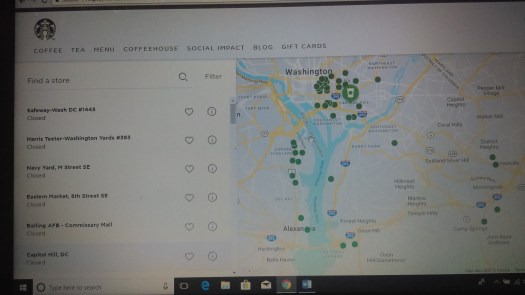
IMAG1017
Southeast DC is predominantly black. It is also almost completely lacking in Starbucks, just like many other American neighborhoods where people of color are in the majority. This picture taken by me.

Celebrating One Year of the Blog!

One year ago as of last Wednesday, I made my first blog post. It was also the post I was probably the most nervous about making, as I have a major fear of failure and that fear crept in once I made my first post.

One year later, that fear is gone!

Of course, I’m helped by the fact that my blog is not a failure. Quite the opposite—after over 50 posts, over 225 followers between the three networks I’m connected to (WordPress followers, Facebook likes, and Twitter followers), and my first blog award, I’d say that I’ve had a successful first year!

What’s more important than the basic statistics, though, is that people have told me, on many occasions, that these posts have helped expose them to injustices they didn’t even know about before. The purpose of my blog was, is, and will be to do exactly that: expose us to injustices that we’ve been blind to or have blindly committed.

So, with one year down, happy birthday to my blog!

P.S. Please note that there are a few times this spring/summer when I will not make my scheduled Tuesday post: May 29 (day after Memorial Day), July 3 (day before Independence Day), and September 4 (day after Labor Day).

Institutional Racism Series: How it Affected Where I Went to School

I went to a great elementary school from 5th to 8th grade, a high school I loved, and a great college. While I sometimes had small complaints, such as having too much homework or dealing with the stress of end-of-year exams, I was extremely lucky to get the education I received.

However, for several months in 2004, the educational system in New York viewed my family as a family of color (even though we’re white), and the results for a time cast uncertainty over where my younger brother would go to kindergarten.

This uncertainty was the result of institutional racism, or racism that is practiced and sometimes even normalized by social, economic, governmental, and other institutions.

The beginning of this story was during the 2003-04 school year, when my family was trying to get my younger brother into the kindergarten program at the public magnet school I went to at the time (which drew students from districts throughout New York City’s borough of Queens). What happened was that the school changed its “sibling policy”—the school previously had automatically admitted siblings of students already attending the school, but the policy changed so that siblings of students were limited to being somewhere between 10% to 20% of new student admissions.

The justification for this policy was to diversify the school—administrators viewed the school as drawing “too many” students from certain districts throughout Queens and “too few” students from other districts; the “too many” were usually from districts that predominantly had students of color, while the “too few” were usually from districts that predominantly had white students. In order to diversify the school, the sibling policy was changed so that the school didn’t get many more kids from districts drawing “too many” kids (mostly districts of color, as I said earlier). Indeed, as someone at the New York City Department of Education told my parents, administrators wanted more kids from places like Bayside and Douglaston (neighborhoods in Queens that were extremely white). In other words, they wanted more white kids at the school and fewer people of color.

At this point, you’re probably reading this and saying the following: “Now, wait a minute, Brendan…you’re white! You’re not a person of color! So what do you or your family have to do with all this commotion?”

Where we came into the commotion was that the school system viewed my entire family, including my brother, as people of color. Since I lived in a Queens neighborhood dominated by people of color, the system viewed my brother as a person of color and therefore as a person who would not achieve the goal of giving my school a more “diverse” student body (more white people). Basically, the educational institution in New York viewed my family as people of color for several months in 2004, and as a result my brother couldn’t get into the kindergarten program we wanted to get him into. My parents said nothing to argue with this misperception because they didn’t want to use our race to give my brother an advantage on the sole basis of the color of his skin.

Then things changed.… Once the educational powers that be saw me mark myself as “white” on a standardized test, they realized that my brother was probably also white and they suddenly offered him a seat at the school. It was too late, though, because my brother started kindergarten at a Catholic school he loved, and I transferred to that school.

The story ended on a positive note for my entire family because we had the money to pay for Catholic elementary school for my brother and me and avoid the public school system entirely after transferring.

However, as I’ve shared this particular story in talks with friends, I have found out about people who had similar issues in their own school systems, but were not so lucky because they were people of color who came from families without many economic resources. Indeed, institutional racism in education prevents some great kids from having the educational opportunities they deserve.


Note: If you missed my previous two posts in my series on institutional racism, please refer to my introductory post for the series and the post on how institutional racism affected where I (and others) live.

Earth Day 2018: A Call to Action

Next Sunday is Earth Day. So in advance, I wish everyone a happy Earth Day!

However, I don’t feel that it’s enough to just wish ourselves and others a good Earth Day. We need to take action too.

The action I propose for this year is that all of us think about the ways in which we use too much plastic and don’t put plastic where we should.[1]

Indeed, when we go to fast food restaurants, we’re given plastic tops for our drinks and straws made of plastic. We go to grocery stores and buy plastic water bottles. We throw our plastics away on the street or in the regular trash, often because that is the most convenient and expedient thing to do. We have plastic bags at grocery stores, and then throw them away in the regular trash once we use them for our one purpose (carrying groceries). So much of our food uses plastic wrapping, and we use plastic bags to help seal and protect food.

Granted, some of the onus is on companies and the government. Companies that use plastic in its products can have a hand too in at least making sure that their products are recyclable, so that the plastic we use causes as little harm to the environment as possible. Government can also have refuse-disposal cans not only for trash, but for paper and plastic as well.[2]

But some of the responsibility is in the hands of us as individuals. I don’t pretend to be holier-than-thou, as I have used and continue to use more plastic than I’d like. However, just because I struggle with some or all of these things doesn’t mean that I (and others) shouldn’t try to do better. We should all try to do better, because I highly doubt that many of us are as good as we could be. We can at least cut plastic out of our lives when plastic is not necessary; for example, when we’re at sit-down restaurants, we don’t need straws and can politely ask not to be given straws. We can also use tap water (with maybe a filter) instead of plastic water bottles. And, if you are a decision-maker in a company or in government, you can advocate for measures that could increase the recycling of plastic or cut down on plastic usage.

I, for one, commit to trying to be better about refusing to use plastic straws, as well as recycling my plastic when I am out in public. I hope that others use the upcoming Earth Day to make a commitment to cut down on plastic usage and recycle the plastic we use.


[1] This is in line with the Earth Day Network’s focus on plastic this year.

[2] In every municipality I’ve been in, including New York City, they make the baffling decision not to do this everywhere.

Some Subtle Ways that People with Mobility Issues Aren’t Accommodated

A few days ago, I was hobbling along with a hurt ankle. I am now 100%, but my ankle was really hurting and limiting my mobility for a few days.

I am not going to use today’s post to talk about my hurt ankle, but I will use my experience with it to hopefully expose readers to a some subtle ways that people with mobility issues aren’t accommodated[1]:

Our Own Behavior

During my time with a bum ankle, there has been many a time when people have tried to push through me or push past me without the courtesy of an “excuse me” while trying to get from point A to point B.

Often, we are so obsessed with getting from point A to point B in a timely manner that I fear we aren’t conscious of some of these behaviors. In the process, we push around people, shove people, and honk at people on the road who are walking too slowly for our liking but who really aren’t capable of moving any more quickly than they are. I know this because, regrettably, there’ve been times when I or friends I’ve been with have been that jerk who gets tries to rush someone with mobility issues without even a simple “excuse me” or an “I’m sorry for bumping into you.”

Now the tables have been turned on me. Now it is others who weren’t treating slow and mobility-limited Brendan with courtesy. The tables may be turned on others of us one day, and I hope we can show respect to people with mobility issues before we become the ones with such challenges.

Some Escalators Move Too Quickly

I work near a subway stop with escalators aplenty. This seemed great to me…until I realized that the escalators move so quickly that I would need to push myself to get on without tripping and falling.

So I guess I should’ve been on the elevator instead, since this subway stop also has elevators. But in cases where the only access for people with limited mobility is an escalator, a quick-moving one is a real problem. I’m just glad that I haven’t taken a tumble yet while trying to get on or off one of these high-speed escalators.

Crosswalk Signals Are Also Too Quick Sometimes

There have been a few occasions before when even able-bodied Brendan struggled to get from one part of an intersection to the other in the time between when the light changed to “walk” and when it changed back to “don’t walk.” If I had a hurt ankle though…forget about it.

The solution here is obvious: make sure the crosswalk signals leave enough time for people to cross the street easily. And yet, that’s not done!

Elevators Are Sometimes in Areas That Make People Feel Unsafe

Speaking of subways, I get on a subway stop that has elevator access. However, this elevator is over by what is, without a doubt, the most isolated section of the subway station. It’s so isolated that even I, a person who had years of karate training, wouldn’t feel safe, particularly at night.

I guess what I’m trying to say here is that, if we have accommodations for people with mobility issues in places where people feel unsafe, it defeats the purpose of the elevator access.


Of course, there may be other ways that people with mobility limitations are excluded. However, I am going off the knowledge from having a few days with a bad ankle, so I may have forgotten other key points. If there are other things I should’ve included, please comment below!

On the other hand, if you weren’t aware of these things before, I hope you are aware now!

[1] To me, any accommodation issue that might not be noticed easily by able-bodied people fits into the category of “subtle.” I acknowledge that what may be subtle to me might be painfully clear to even some other able-bodied people.