The Importance of Recognizing Pioneering Figures on Injustice-Related Topics

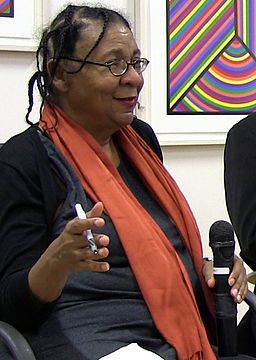
An image of bell hooks from 2014. Alex Lozupone (Tduk), CC BY-SA 4.0 https://creativecommons.org/licenses/by-sa/4.0, via Wikimedia Commons

Some time ago, my family was at a bookstore that was clearly leftist politically. I could tell that because there were lots of books on LGBTQ+ themes, racial justice, and feminism, to name a few.

And yet, the bookstore felt lacking. Namely, it was lacking in works from pioneering figures on LGBTQ+ issues, on feminism, on racial justice, etc. There was no Audre Lorde, no bell hooks (bell hooks on the shelves would’ve been timely as I visited this bookstore just a couple of weeks after her death), no Angela Davis, and so on. (By the way, if these names are unfamiliar to you, I definitely encourage you to learn more about all three of them.)

This was, of course, unfortunate to me. But, at the same time, this bookstore made me think about whether I, too, don’t give the pioneering figures on injustice-related topics the credit or attention they warrant. And the bookstore made me think about other instances when said figures don’t get the recognition or attention they deserve. It made me think of the #MeToo movement, when people often didn’t (and, in some cases, still don’t) give due credit to how foundational Tarana Burke, who started using “metoo” over a decade before it trended on Twitter for many of the same reasons that people used the hashtag on social media,[1] really was. It made me think of all the talk about Critical Race Theory, little of which ever acknowledges the work of those who were pioneering on the issue (regardless of whether one agrees with Critical Race Theory). And it makes me think of all the things I’ve read about intersectionality—a big topic in many social justice circles (read more about intersectionality in this blog post I wrote on the topic)—that do not even mention pioneering figures on the subject, such as Kimberlé Crenshaw.

Keeping my mind at least somewhat on the disappointing bookstore I was at, what I am saying here is that, as underwhelming as the bookstore may’ve been, it’s far from existing in a bubble. Many of us, myself included, also struggle with giving pioneering figures on various issues of injustice the attention they deserve. If anything, the bookstore is only a microcosm of this larger issue.

But why should I, and we, care about giving such figures the recognition that they deserve?

Simply put, we should care because, in many cases, what some of us may find ourselves reading, writing, and researching on today is the result of what those before us wrote and spoke about. Even if we happen to come up with new ideas, the inspiration for them comes from somewhere, and it seems only appropriate that we recognize where they come from and give credit to the origins of said ideas.

So, in order to try and avoid being like that bookstore, I, and we, should really try to redouble our efforts to acknowledge and give credit to the foreparents behind many of the injustices some of us may find ourselves talking about. In some cases, if not many of them, I don’t think it’s a deliberate ignoring of people (though I could be wrong). But that is why the effort needs to be made to deliberately recognize, acknowledge, and appreciate those like Audre Lorde, bell hooks, Angela Davis, and many others.


[1] https://time.com/6097392/tarana-burke-me-too-unbound-excerpt/

American Health Care and Responding to the Long-Term Impacts of the COVID-19 Pandemic

With the Omicron variant having settled down, it seems like the “health care system” (putting that phrase in quotes because, in the words of a former journalist by the name of Walter Cronkite, I believe it is “neither healthy, caring, nor a system”[1]) can perhaps take a bit of a breather, at least until the next variant. If there is another catastrophic variant, that is, and I hope there won’t be one.

Yet, even if there isn’t another variant, health care systems around the world, including the one in the United States, will in a way be responding to the long-term impacts the pandemic has had on people for years, if not decades, to come. And I am concerned about the American health care system not giving people with said impacts the sort of health care that is required.

But first of all, who are the people with these long-term impacts?

Some of us will possibly be COVID long-haulers who will need physical health care. We are learning more about the long-haulers as we go along, but it may turn out that some will end up with long-term or even permanent impacts that will affect their daily lives due to neurological conditions,[2] among other things. Regardless, the long-haulers are a population that will be dealing with long-term impacts from COVID, quite possibly, long after the pandemic ends.

However, many more of us will be people who need mental health care of various kinds due to the emotional trauma that the circumstances of COVID have caused. A wide range of populations will need this mental health care in some way, shape, or form, ranging from family members who lost loved ones due to the pandemic, to hospital workers who have emotional trauma from working in hard-hit hospitals, to people whose personal economic fortunes turned completely upside down due to the pandemic and never recovered. Dealing with the effects of trauma can be lifelong, and as such, dealing with the effects of COVID-related trauma may also be lifelong.

I have no idea how many people will need COVID-related physical health care and how many will need COVID-related mental health care after the pandemic, but I’m guessing that it will be a sizeable number of people in the United States—perhaps in the hundreds of thousands, and perhaps even in the millions. What I do know is that there will likely be a lot of people who will need one or both things, and that if preparations are not made for that long-term reality now, people are going to be hurt quite badly (physically, emotionally, and otherwise) by how poorly prepared our health care system is, by how American health care has a nasty tendency to leave people either uncovered or undercovered for so many basic needs.

Nor do I know what preparing for such a reality may look like, as I am not a health care expert. Frankly, I’m not even sure if a lot of health care experts know what preparing for such a reality may look like, either. I’m not even sure if it’s possible for a health care “system” as broken as the one in the United States—a “system” where millions are uninsured, where millions more are denied coverage for so many basic needs, and where the politicians that could change this would rather keep the status quo then actually fix these problems—could ever be truly prepared for the potential enormity of caring for scars, both physical and emotional, that come from this pandemic. Possibly not. But if it is possible, those preparations need to happen, and happen now.


[1] https://www.goodreads.com/quotes/74350-america-s-health-care-system-is-neither-healthy-caring-nor-a

[2] https://www.nbcboston.com/news/local/boston-doctors-explain-long-covid-and-neurological-symptoms/2509459/

On How We Treat All Refugees

An image of a Ukraine flag

One of the heartwarming things in what has been a destructive and heartbreaking war between Russia and Ukraine is the treatment of refugees from Ukraine, at least from what I’ve seen on news television. It has been wonderful to see the kind treatment of Ukrainian refugees entering into Poland, for example.

But at the same time, upon seeing the footage of how Ukrainian refugees have been treated, my mind couldn’t help but turn towards how so many parts of the world have struggled with how we’ve treated refugees from other places. And that’s not to say that Ukrainian refugees shouldn’t be treated with the utmost care and respect, but that instead we should treat all refugees from war-torn areas, politically unstable areas, and places ravaged by the impacts of climate change (to name a few) with the same sort of basic human decency that has been given to so many refugees from Ukraine.

And yes, that includes refugees from war-torn Syria. That also includes refugees from Honduras, which has suffered from major weather disasters and drug violence. That includes those fleeing from the Taliban in Afghanistan, political violence in Myanmar, and many other issues in many other parts of the world.

And yet, we (we applying not just to the United States, but to many other countries as well) often don’t treat refugees with the same sort of human decency that some Ukrainian refugees are receiving. We turn them away at the borders. We tell them to go back to their home countries, in the process returning to the violence or other unrest they had hoped to escape from. We tell them that there is no room for them in “our” country. We tell them that they would damage the country’s economy. We all too often show deep selfishness.

And that’s not to say that there are challenges that come with having a massive influx of refugees in a short period of time. Such an influx means that there is a sudden need for a wide variety of services (and a wide quantity of services) in places that may not have them, or at least not have them to the extent needed in order to take care of everyone present. Everything from doctors to bathrooms are needed in great supply in places having a large influx of refugees, for example. The challenge that comes with this is great. Yet, at the same time, giving our fellow human beings some relief and refuge during a time of great chaos and upheaval and loss should by itself make those challenges worth it.

So yes, may we welcome refugees from Ukraine, and may we stand with Ukraine and refugees coming from that country. But may we also welcome refugees from Honduras, Syria, Afghanistan, Myanmar, and many other parts of the world.

Coronavirus Update From New York City: March 3, 2022

I hope everyone is healthy and safe, regardless of where you are.

Personally, everyone in my family remained (knowingly) COVID-free throughout the Omicron variant, thankfully (though it’s always possible that one or more people in my family got it asymptomatically). Even though there were some nerves about remaining that way throughout, we got through it. Things are now coming back to a modified normal for my immediate family–returning back to a physical office for me, retuning to church for my family, and eating indoors at places that are either: a) not crowded or b) checking for proof of vaccination (and not every restaurant is checking for proof of vaccination, but more on that later in this post).

In New York City, all the COVID numbers, from test positivity to rate of infection, look so much better now than they did even at the start of February, when I curtailed the weekly COVID update posts and scaled them back to monthly posts again. In fact, the numbers are looking good enough (Or is it that people are sick and tired of COVID? Or both?) that some restrictions are being scaled back. The requirement that you must show proof of vaccination in order to eat indoors in New York City, for example, is expiring on March 7th.

I personally have mixed feelings about the removals of some of these restrictions.

Some of the restrictions, such as the restaurant and gym vaccine proof requirements, felt somewhat moot at times because many such places were not checking vaccination status to begin with (and I get that to an extent because there have been a few violent encounters involving anti-vaccine types at places where proof of vaccination was required; those encounters may’ve spooked some restaurant workers elsewhere, for example). Or, at least in my experiences some (Many?) places were not checking proof of vaccination in New York City.

But at the same time, I fear that loosening up too much, too quickly (even on mandates that are unevenly dealt with, such as proof of vaccination requirements for restaurants and gyms) will result in the most vulnerable being left behind–namely, those who are immunocompromised and families with kids under the age of 5 (kids who are therefore unable to get vaccinated). I fear that we are looking to move on without thinking about the most vulnerable among us as these policy decisions are being made. Of course, as I’m typing this, I recognize the fact that decisions and policies, on both a small scale and a larger scale, are made on a daily basis without keeping in mind those who are most vulnerable. But still, I am concerned that this is the case here.

But those are my thoughts, in any event. As always, I’m happy to hear how readers are doing!

On Book Bans

In the last several weeks, there’s been a lot of attention on the fact that some schools and school districts are banning books that they think are inappropriate for one reason or another. Proponents of banning certain books are arguing that by not allowing certain books in, their kids are somehow being “protected.” And then, on the other hand, opponents of the banned books are arguing that the banning of some of them in certain schools and school districts is shameful.

However, what gets lost in the whole discussion on book bans is the fact that the sense of protection that comes from book bans (among those in favor of the bans) is a false one.

But why would I say that?

Let’s think about the sorts of book bans that give some groups of parents a sense of protection: ones that focus on books with certain profanities, with certain takes on racial issues, or with characters who are openly LGBTQ+ (or with certain takes on LGBTQ+ issues), to name a few.[1] Some may think that by banning such books, access is being restricted on the topics the books address. In reality, information on all these things—the profanities, the takes on racial issues that result in certain books getting banned, and LGBTQ+ stuff—is just a Google search away. All one is doing by banning books is simply changing the medium through which many people gain access to the sort of information they might acquire through the banned book. This is one reason I say that book bans provide a false sense of protection for those in favor of the bans.

But there is another reason I argue this: one can get a book through means other than reading it at school. A book as popular as To Kill a Mockingbird is one that a curious kid could buy with some allowance money (depending on how much money it is) at the bookstore closest to school or home. Some of these books can be easily checked out at local libraries for no money at all. Many of them are available on places like Amazon, provided the parents are willing to use their credit card to purchase the book for their kid. All that banning a book does, in some cases, is allow book retailers to make money off of selling the banned book to interested and curious minds.

However, even if one didn’t seek out information on transgender people through a Google search or check To Kill a Mockingbird out of the local library, there is one inescapable fact: the issues covered in some, even many, of these banned books are issues that many of us are likely to face at some point in our lives. You can ban a book with a gay couple in it, but when a friend of yours comes out to you as gay,[2] there is no escaping LGBTQ+ issues. You can ban a book perceived as having a message that is too anti-police, but at some point, someone is likely to run into someone else who believes wholeheartedly in the message of the Black Lives Matter movement. Because of the aforementioned inescapable fact, I’m of the mind that while one’s exposure to the information in many of these banned books may sometimes be delayed, it cannot be escaped forever. It’s simply not possible in this world, short of living in an extraordinarily tight bubble (and even then, there is information that can seep in through that bubble).

The previous paragraph brings me to the real injustice with regard to book bans that needs to be talked about, which is the fact that it leaves some people unaware about certain major topics and issues in our society until confronted with those topics or issues. To me, that is a real injustice because, quite frankly, it does not seem healthy to leave people unaware until that critical point, because that is a point when decisions can be (and often are) made from a place of insecurity, ignorance, and stress—a place that can lead to bad decision-making with regard to how they treat their friends, neighbors, colleagues, and family members.


[1] I’m not making this stuff up. Those are three of the things that come up the most frequently on the American Library Association’s list of most banned and challenged books over the past few years: https://www.businessinsider.com/guides/learning/banned-books-2021#george-by-alex-gino-1

[2] Yes, I have a good friend who came out to me as gay relatively early in his coming out process. True story.