Coronavirus Update From New York City: May 6, 2021

Today’s COVID update post is somewhat less exciting than last week’s update post, for I do not have a vaccine (or its side effects) to report on. That being said, I am a few days away from having the maximum immunity built up (I took my second dose a week and a half ago), so having full immunity will be exciting.

There has been much talk about what someone can do if they are fully vaccinated. Given all the discussion on what a fully vaccinated person can do (or should do), and what a fully vaccinated person should still be cautious with, I’m going to get involved in that discussion by talking about how I plan to conduct myself once I am at maximum immunity starting in a few days. The goal of talking about how I plan to conduct myself once I have that immunity built up is to hopefully get others thinking about how they want to move forward when they are fully vaccinated.

How I plan to conduct myself, in terms of the activities I am willing to do, will depend on answers to several questions:

  1. What COVID-19 variants are around? Furthermore, are said variants deadly? And if said variants are deadly, how well do my Moderna shots protect me from getting those variants? If there are deadly variants around, I want to be sure that my Moderna shots protect me from getting said deadly variants. If I’m not sure whether the Moderna keeps me from contracting a deadly variant going around, then I would still act with some level of caution. To use a relevant example, unless there is information I have missed, there’s still more to learn about how well the vaccine responds to the deadly Indian variant, so I will want to act with a bit of caution (especially when it comes to the riskiest activities from a COVID standpoint, such as dining indoors and being in crowds indoors). According to Dr. Anthony Fauci, Director of the U.S. National Institute of Allergy and Infectious Diseases, the Covaxin vaccine that’s being used in India is preliminarily showing promise against this variant,[1] but alas, the vaccine shot I got was not Covaxin but Moderna. One note I should add is that if we’re in a place where none of the variants are deadly and/or the Moderna vaccine is known to be effective against the most serious variants that are around, then I would be willing to engage in even the riskier activities (though I imagine there will be a mental barrier to get through on the first occasion that I, say, dine indoors for the first time since pre-COVID).
  2. How much community spread is there of the virus where I live, and how much community spread is there where I want to go? Even if I’m unsure how well my Moderna shot works against certain variants, if community spread of COVID-19 is pretty low, then I would feel safe with a wider variety of activities than if community spread were pretty high. In my case, I live in a county (Queens County) where the rate of infection is below 1.0,[2] which in layperson’s terms means that at the rate we’re going, we’re going at a rate to slow and hopefully eventually stop the spread of the disease.[3] As such, I might be willing to do somewhat more in terms of activities (especially given that I’m fully vaccinated) than I would even if I were vaccinated and community spread (particularly spread of variants with unknown effectiveness with the Moderna) were widespread.
  3. If we don’t know whether my Moderna shots react to a deadly variant going around, is the activity I’m thinking of an activity that’s relatively safe even if I were unvaccinated? We have a fair bit of data of which activities are safe or unsafe for even unvaccinated people, and the results may be surprising. For all that public transport has a reputation for being a germ factory, for example, there is no correlation found between riding subways and COVID-19 spread.[4] On the other hand, if you are indoors in a place with poor ventilation, having six feet of distance between yourself and someone else may not be enough.[5]

Before wrapping up my post, I should also note that the United States Centers for Disease Control and Prevention (CDC) has its own chart on which activities are and are not safe for both fully vaccinated people and unvaccinated people.[6] My approach to COVID as a fully vaccinated person seems to be a little more cautious than what the CDC’s guidance lays out currently, but at the same time, the CDC’s guidance is worth noting because as I have said to my parents on multiple occasions, following their guidance has helped me get this far without catching COVID.

While I don’t know how much (if at all) my readers will agree with my guiding principles for what activities I do, post-vaccination, I hope that at least this post will get other people thinking about what they do after getting vaccinated. Overall, getting the vaccine is worth it to me because it protects us against so many troublesome variants, but I plan on acting with caution with certain activities until we learn more about how the Moderna vaccine responds against other troublesome variants; notably, the Indian variant.


[1] https://www.whitehouse.gov/briefing-room/press-briefings/2021/04/27/press-briefing-by-white-house-covid-19-response-team-and-public-health-officials-32/

[2] https://covidestim.org/us/NY/36081

[3] You may’ve heard that in certain places, the rate of infection is “below 1.0” or “above 1.0.” Here, you can find an explanation of what these numbers mean: https://www.yalemedicine.org/news/12-best-covid-19-prevention-strategies

[4] https://gothamist.com/news/new-study-finds-no-direct-link-between-subway-covid-19-spread

[5] https://www.nbcnews.com/health/health-news/6-feet-may-not-always-be-enough-distance-protect-covid-n1238083

[6] https://www.cdc.gov/coronavirus/2019-ncov/daily-life-coping/participate-in-activities.html
What Isโ€ฆ Cultural Appropriation?

When I was a senior at Dickinson College in Pennsylvania (which was in Fall 2015), a HUGE controversy erupted on campus. In short, there was an โ€œAround the Worldโ€ party at the college. At the party, a student posted on his Instagram account a photo of himself and a friend of his wearing sombreros. The photo had the caption โ€œWe swear weโ€™ve got our green cards,โ€ and the photo had the hashtags of #taco, #chihuahua and #tequila. In addition to the Instagram photo, there was a Facebook photo of a male student wearing a white flannel undershirt and a bandana posing with a female student at Dickinson who was wearing a sombrero at the party.[1]

To say that there was anger about the existence of the party, the social media posts, and the people involved in the party would be an understatement. The political climate in the United States was already tense at the time, with then-candidate Donald Trump surging in the polls with inflammatory rhetoric about immigrants, and particularly Mexican immigrants. Therefore, when news of this party and the social media posts from the party spread around the student body at Dickinson, there was an outpouring of fury. In particular, there was fury at the fact that instead of aiming for cultural appreciation, the party and all involved with it instead performed acts that were considered by many to be cultural appropriation.

But what is cultural appropriation?

Cultural appropriation is defined by the Oxford Dictionary as, โ€œThe unacknowledged or inappropriate adoption of the customs, practices, ideas, etc. of one people or society by members of another and typically more dominant people or society.โ€[2] Whether we realize it or not, cultural appropriation actually happens on an everyday basis. When, without acknowledgement, you use Arabic numerals to help you with your math, make food from other cultures, and wear a form of clothing design that comes from a culture not your own, you are performing acts of cultural appropriation.

However, itโ€™s not those everyday instances of cultural appropriationโ€”those instances where the cultures responsible for the numbers we use, the food we eat, and the clothes we wear are not acknowledgedโ€”that seem to get the most flack (either rightly or wrongly). Instead, it is making fun of or otherwise mocking a certain culture/group of people that gets the most flack. Such actions fit within the definition of cultural appropriation, but might also fall into the realm of another term I hear less often: cultural mockery. Cultural mockery happens when there is inappropriate misrepresentation, imitation, caricaturizing, or making fun of a culture. The โ€œWe swear weโ€™ve got our green cardsโ€ incident at Dickinson would fall into the category of cultural mockery.

On the other hand, if we are โ€œhonoring and respecting another culture and its practices, as a way to gain knowledge and understanding,โ€[3] then itโ€™s cultural appreciation. One common example Iโ€™ve seen of cultural appreciation is when someone makes the food of another culture (and not just food stereotyped as being from another culture) while explaining the history of the dish and how that dish became so important to the culture. Through that, something as simple as food can encompass not just food, but also the history of the culture (how the dish fits within the history of a culture), the types of crops that the culture relies on (the economy of the culture), and much more.

Some of us may unwittingly fall into cultural mockeryโ€”something that may happen with some frequency with the upcoming Cinco de Mayo. However, if we really want to aim to learn more about cultures outside our own, we should really strive for cultural appreciation, and for actually trying to learn more and understand more about the cultures we arenโ€™t a part of.


[1] Click on the following link to learn about this controversy at my college, Dickinson: https://thedickinsonian.com/news/2015/09/15/photos-draw-anger-apology/

[2] https://www.lexico.com/en/definition/cultural_appropriation

[3] https://attheu.utah.edu/facultystaff/cultural-appropriation-or-appreciation/#:~:text=Cultural%20appropriation%20can%20be%20defined,to%20gain%20knowledge%20and%20understanding.

Coronavirus Update From New York City: April 29, 2021 (Second Vaccine Shot Edition)

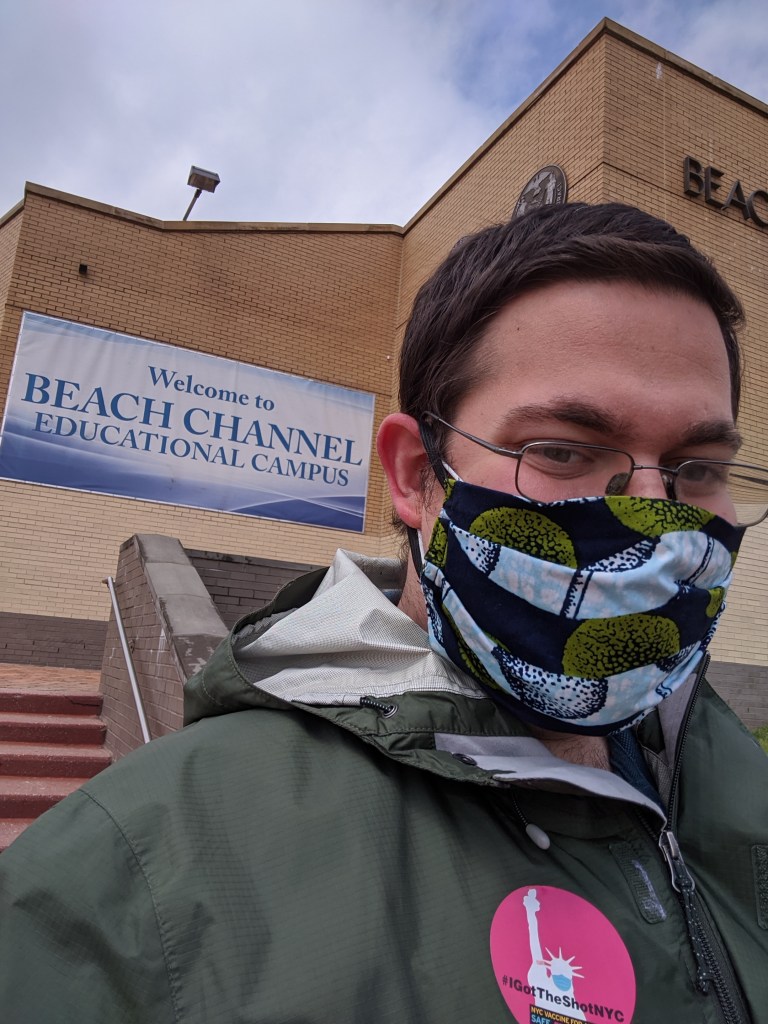
A picture of me after I got my second Moderna COVID-19 vaccine shot

As readers can tell by the title of tonight’s COVID update blog post, I have now received my second and final shot of the Moderna COVID-19 vaccine!

I got the shot last Sunday, April 25th.

The directions for heading into the facility for my second shot could’ve been better, as a number of us were confused as to where exactly we should be going. However, once I got into the facility that was doing the vaccinations, it was a pretty quick and smooth process to get from check-ins to the vaccination, and from the vaccination to post-vaccination monitoring.

As for side effects, they were more severe after the second dose than after the first dose–something which is apparently the case for many people. After my first dose, I just had a sore arm for a short period of time. After my second dose, I started with a sore arm. However, on the night after I received my vaccine shot (night of the 25th/morning of the 26th), I woke up to my shivering. I had chills. In addition to chills and the sore arm, I ultimately had the following side effects:

  • Headache
  • Fatigue
  • Reduced appetite (which for me often comes with having fatigue and/or a headache, so it’s hard for me to say whether this was an actual side effect or the result of other side effects)
  • Fever (at one point, a fever of 100.5)

Such side effects are apparently not unusual, for many people report having low-grade COVID symptoms after their second vaccine dose (with both Pfizer and Moderna) for anywhere between one day and few days. In my case, the most severe side effects lasted for 24 hours (with only a little bit of arm soreness after I recovered from other side effects). However, each person’s body is different, and as such, each person’s reaction to their second vaccine dose is going to be different. Regardless, if you feel unwell for a day or two or even three, don’t panic. If you still feel unwell even after a few days have passed, I would recommend calling a doctor.

Obviously, in terms of side effects, you want to hope for the best. Still, if you want to “prepare for the worst” (which is nothing compared to actually having COVID), those who are taking their second vaccine doses should be prepared to:

  • Potentially feel unwell for somewhere between one day and a few days
  • Drink lots of water if you feel unwell (a special shoutout to the friends of mine who told me the same thing)
  • Rely on the help of others for a day to a few days (or, if you have nobody else to rely on, prepared to not do much for a day to a few days if at all possible)
  • Use sick leave at work, if your job has such a thing as sick leave

For all that I’ve talked about my side effects from the second Moderna shot in this post, I should emphasize that I have zero regrets about getting the second shot. If I had to make the same decision all over again about whether to get a second shot, I would get my second shot without the slightest bit of hesitation. Likewise, I would urge others to not be hesitant about getting that second shot, even with stories of side effects from people like me. For one thing, the science says that you need both vaccine shots of the Pfizer and Moderna in order to have maximum protection, so while some are foregoing their second shots because they believe they have adequate protection from COVID, the science simply does not match up with that belief.[1] For another thing, while one can experience side effects from the second vaccine shot, the side effects are child’s play compared to actually getting symptoms of the virus–a virus that has killed nearly 3.2 million people worldwide as of the time of my writing this post. As such, I beg those who are hesitant about having a second vaccine dose to keep things in perspective, and remember that having COVID (or putting yourself at risk for having COVID through not being fully vaccinated) is much riskier than having a COVID vaccine (even the Johnson & Johnson vaccine, which is a single-shot vaccine and has had blood clot issues reported with a tiny number of vaccine recipients).

I know that my paragraph above was rather lengthy, but given that apparently close to 8% of people in America who’ve received their first shots of the Pfizer and Moderna not receiving their second doses, I want to do my part in addressing the hesitancy that seems to exist with regards to getting a second shot (a lot of which seems to center around concerns about side effects as well as the belief one is protected). A lot of the talk around vaccine hesitancy is centered around getting a shot to begin with, but there’s also hesitancy around getting a second shot–hesitancy that I think those of us who have received our second shots have a moral obligation to address as best as possible.

If other readers have received their second shots of the Pfizer or Moderna, or received their single-dose Johnson & Johnson vaccine, please let me know if there’s anything to add beyond what I covered in this post!


[1] https://nymag.com/intelligencer/2021/04/millions-of-americans-are-skipping-their-second-covid-shot.html

Transit and the Environment

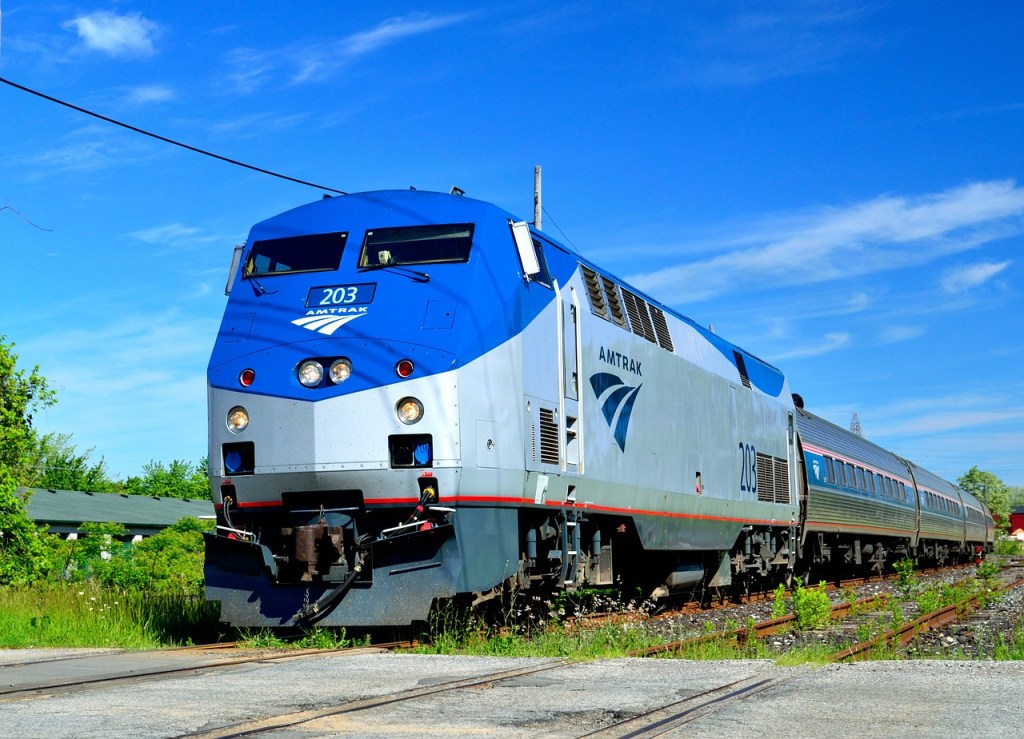
An Amtrak train

A couple years ago, I traveled to see one of my best friends get married. That was a special day for me, seeing one of my best friends marry the love of his life.

The day before and the day after the wedding, the train ride I took was very pretty. However, I experienced and learned more about how second-rate of a train โ€œsystemโ€ Amtrak, the intercity/interstate passenger rail system we have in the United States, really is.

My experience was interesting, to say the least. I was obsessed about making my train in good time because this was the only train going between New York City and Pittsburgh, Pennsylvania (my destination). My Pittsburgh-bound train was delayed, by as much as forty minutes at one point, because we were stuck behind two freight trainsโ€”something that wouldnโ€™t happen if Amtrak owned its own tracks and therefore had control over which trains travelled through and when. The cafรฉ car on the way back to New York had food about twice as expensive as fast food at a highway exit (and less edible than McDonaldโ€™s).

Then, there was what I learned before, during, and after my train ride. Before the train ride, I already knew that some major cities in the United States, such as Las Vegas, Nevada and Nashville, Tennessee, do not have any train service. During my visit, I learned that Pittsburgh, a city of about 300,000 people, had only three train departures a day at the time: one that left for Chicago at 11:59 PM, one that left for Washington, D.C. at 5:20 AM, and one that left for New York at 7:30 AM (the train I took back to New York).  And since my train ride, Iโ€™ve learned that itโ€™s actually quite common for trains to be delayed because Amtrak does not own many of the tracks it provides service on, therefore creating a situation where they are often stuck behind freight trains and delayed by many minutes.

Itโ€™s as if Americans are being actively discouraged to take commuter rail. And that is horrendous for the environment.

The largest source of greenhouse gas emissions in the United States is transit.[1] These greenhouse gases, which trap heat and help make the planet warmer, make our air toxic and contribute to global warming.[2] Considering the fact that transit is the number one cause of these emissions, it is appalling that transitโ€™s role in damaging the environment, as well as the role it needs to play in helping the environment, seems to get discussed relatively little.

But how should discussions on transportation and the environment start? I have a few ideas:

  1. It must be recognized that transportation is a major reason why our air is dirty and the environment is not in the shape that it should be. As I said before, transit is the biggest emitter in greenhouse gases, and until we recognize that, transit wonโ€™t be a factor that is considered seriously when reviewing environmental policies.
  2. If the United States is serious about cutting transit emissions, the country must prioritize mass transit over cars and airplanes. Study after study shows that buses and trains are way better for the environment than cars and airplanes. Yes, ultimately there need to be disincentives for driving and flying within the lower 48 states,[3] but if youโ€™re in Las Vegas and have zero Amtrak service, then your only options for intercity travel are either a car or an airplane. There need to be greater disincentives for driving within cities, but if public transportation does not take you to where you want to go, then you have to drive.
  3. Municipalities should make their areas easier to walk or ride a bike. The city kid in me always used to give a bemused chuckle when I heard people talk about needing to drive everywhere, even if itโ€™s three minutes away, because they couldnโ€™t walk anywhere. That needs to change. By making spaces easier for pedestrians and cyclists to navigate, we can cut down on the countless three-minute drives to schools, grocery stores, doctors, etc., that wouldnโ€™t be necessary with good pedestrian and bicycle infrastructure.
  4. We need cars and planes to burn less in the way of greenhouse gases. While cars and planes are so damaging to the environment, some people will still need to use cars and/or planes to function personally and/or professionally. Policy looking to reduce greenhouse gases coming from transit should look to reduce the amount of greenhouse gases that come from a car or a plane.[4]

After reading all of this, readers can see why Iโ€™m so mad about the state of Amtrak and public transportation in the United States in general. Sound environmental policy would work on building Amtrak into a world-class system, work on building other public transport infrastructure, and improve infrastructure for pedestrians and cyclists. Sadly, the United States currently does the oppositeโ€”it makes environmentally friendly modes of transport as slow, unreliable, expensive, miserable, and in the case of walking and riding a bicycle, as unsafe as possible. Hopefully, with Earth Day having recently happened, and with a concrete proposal on the table to invest in public transit at the national level,[5] we can push our politicians to advocate for more extensive mass transit in the United States, and push ourselves away from cars and airplanes whenever it is possible to do so.  


[1] https://www.epa.gov/ghgemissions/sources-greenhouse-gas-emissions#targetText=The%20largest%20source%20of%20greenhouse,Greenhouse%20Gas%20Emissions%20and%20Sinks.

[2] Yes, I believe in global warming/climate change.

[3] While climate activist Greta Thunberg recently traveled between Europe and the U.S. by a zero-emissions yacht, those travels took a week (I think) and many of us do not have a week to spend in the ocean because of family and/or job commitments. Therefore, airplane still seems to be the most convenient mode of cross-ocean travel, as environmentally unfriendly as that is.

[4] Note that this does not necessarily mean going over to electric cars. Electric cars have their own set of environmental risks, including from the carsโ€™ batteriesโ€”something this article talks about: https://www.usatoday.com/story/news/factcheck/2020/10/17/fact-check-electric-cars-emit-less-better-environment/3671468001/

[5] President Bidenโ€™s infrastructure plan calls for spending $80 billion to improve passenger rail service: https://www.reuters.com/article/us-usa-biden-infrastructure-mass-transit/analysis-biden-infrastructure-plan-bets-big-on-u-s-return-to-mass-transit-after-covid-19-idUSKBN2BN3O2. I am not enough โ€œin the weedsโ€ of transit policy to know whether this will be enough money to make Amtrak a respectable national rail system, but considering that the amount of fiscal support Biden wants to dedicate to passenger rail dwarves the approximately $2 billion a year Amtrak currently receives in government support (https://www.cnbc.com/2020/09/09/amtrak-passenger-railroad-needs-up-to-4point9-billion-in-government-funding-ceo-says.html), itโ€™s a proposal worth discussing.

Coronavirus Update From New York City: April 22, 2021

I hope everyone is healthy and safe, regardless of where you live.

I am on the verge of being fully vaccinated! I am scheduled to get my second dose next Sunday. I look forward to being fully vaccinated, even if there are certain public health precautions I should follow even after vaccination. Next week, I will make sure to give a full report of how the second dose went and how I felt after the shot.

Thankfully I have not heard of any other deaths of friends of friends, friends of family, colleagues of family, etc. in the past week, so that is nice for a change. I know that a couple of my COVID update posts recently have been on the sorrowful side, so it’s nice not to have tonight’s post be on the sorrowful side as well.

In other positive news, the hospital closest to where I live is under somewhat less stress from COVID now than it was a number of weeks ago. While a significant number of hospital beds and ICU beds are still taken up by COVID patients, those numbers are not as high as they were several months ago. To give my readers a contrast of how much things have changed in this regard, at one point nearly 80% of ICU beds were taken up by COVID patients at the hospital closest to where I live,[1] but now that number is down to 43%.[2]

The test positivity rate in my part of New York City is 7.9%, which is slightly down from where the test positivity rate was at this point last week. People continue to get vaccinated, but with my neighborhood’s numbers the way that they are, and with my city’s numbers the way that they are (test positivity rate is just above 6%), it’s a reminder that COVID is still very much going around.

One disclaimer I should add to this post is that the situation I’m reporting on is the situation in New York City, and in my part of New York City, at that. What may be the case where I live is not necessarily the case nationwide in the United States. I offer this reminder as I hear about parts of the United States going through yet another wave of this virus.

I’m more than happy to hear how my readers are doing. Hopefully everyone else is staying healthy!


[1] https://blindinjusticeblog.com/2021/02/18/coronavirus-update-from-new-york-city-february-18-2021/

[2] https://www.npr.org/sections/health-shots/2020/12/09/944379919/new-data-reveal-which-hospitals-are-dangerously-full-is-yours#lookup