How Crosswalks are Still Ableist, Even With Disability Laws

For able-bodied people, going through a crosswalk is pretty simple: we get to the street, we wait to have the right-of-way, and then we cross.

For people who are not able-bodied, it is not necessarily that simple. Not only that, but there are actually a number of ways that crosswalk areas are problematic to people who are not able-bodied, and are therefore ableist:

  1. Some crosswalks don’t have long enough light cycles for the people crossing. There have been numerous times where even I, an able-bodied 24-year-old, struggled to cross a street before I lost the right-of-way. If even I struggle with crossing by the time I lose the right-of-way, the problem is even worse for people who are not swift on their feet.
  2. Some crosswalks don’t have any noise cues for people who are blind. Honestly, I’ve always asked myself how a blind person can possibly cross a street without being run over by a car. If this video is any indication, it is difficult at best to cross the street without sound cues. Yes, blind people often seem to rely on sound cues from cars on the street, but many crosswalks (including crosswalks in New York City) lack sound devices to inform blind people on when it is or is not safe to cross the street.
  3. Many crosswalks seem to have the pedestrian right-of-way mostly (or only) activated when a button is pushed to ask for a walk sign. However, from amputated arms to simply an old person struggling to get to that button the person needs to push, there are various reasons why the pedestrian right-of-way activation button is not easily accessible for many individuals.
  4. In many snowy areas, snow is often pushed to the side, to the curb and to…the crosswalks. And sadly, such snow is often not removed from these crosswalk areas. The result is that many street crossings are barely accessible to even able-bodied people like me, let alone those who are not able-bodied.

While crosswalks have improved in some ways—most notably an increasing number of sound cues for crosswalks so that blind people can cross safely, as well as ramps that allow people with wheelchairs to get from the walkway to the street and back to the walkway again—we should not settle for these improvements alone. We should not settle for the aforementioned improvements alone because there are still several ways that crosswalks are not safe for many to cross. Hopefully, the appropriate changes can be made, so that crosswalks are accessible to more than the able-bodied.

The Ableism of Western Masculinity

When I, and others, read definitions of what it means to be “masculine” in the western world, we get words like: active, aggressive, ambitious, analytical, assertive, athletic, authoritative, blunt, certain, competitive, decisive, dominant, forceful, independent, individualistic, physical, protective, self-reliant, self-sufficient, strong and tough.

Some of these meanings of masculinity are perfectly okay—being active, ambitious, analytical and certain, for example, can be positive traits in many circumstances.

Other traits are, in my humble opinion, traits that contribute to gender inequality and so many sexual assaults against mostly women—being aggressive, authoritative, dominant, and forceful come to mind. The topic of how some ideas of western masculinity contribute to gender inequality and sexual violence may very well be the subject for a future post, but I won’t cover this in my current one.

And then there are other “masculine” traits such as: active, athletic, independent, physical, self-reliant, self-sufficient, strong, and tough. These traits are ableist, or discriminating in favor of able-bodied people, at least to some extent, because men who have disabilities are then viewed as completely unable to fit these traits of what it apparently means to be a “true man” or “manly enough.”

Consider the following:

  1. If you are a blind person, you don’t fit into some people’s ideas what it means to be masculine. The definition of masculinity includes independence, self-reliance, and self-sufficiency, yet you need to depend on other people, animals or things to guide you.
  2. If you are deaf person, you don’t fit into what some think it means to be masculine. You need to depend on sign language from others or closed caption coming from a machine, so you therefore don’t have the independence, self-reliance, or self-sufficiency associated with masculinity.
  3. If you need a cane to get around (let alone if you’re in a wheelchair), you don’t fit into our society’s idea of what it means to be masculine. Regardless of what your level of activity is (and I know my share of people who are on a cane or in a wheelchair AND are actually quite athletic), you are often viewed as inactive, unathletic, dependent on others and weak if you use a cane or are in a wheelchair.

The bottom line is that if you are a man with some form of disability, that person likely does not fit the definition of masculinity. In fact, because masculinity is ableist, the very ideas associated with modern western masculinity completely exclude men with disabilities the “manliness club.”

So when I hear someone talk about “toxic masculinity,” I agree—masculinity is toxic. The ableism of masculinity makes masculinity inherently toxic.

Note: I want to thank the blog Me, Myself and Disability for bringing this issue to my attention. When I first discovered that blog, I read a post about the author’s own experiences with the ableism of masculinity. If you want to get a more personal perspective on the ableism of western masculinity, I highly recommend that you read his post on the issue.

Some Subtle Ways that People with Mobility Issues Aren’t Accommodated

A few days ago, I was hobbling along with a hurt ankle. I am now 100%, but my ankle was really hurting and limiting my mobility for a few days.

I am not going to use today’s post to talk about my hurt ankle, but I will use my experience with it to hopefully expose readers to a some subtle ways that people with mobility issues aren’t accommodated[1]:

Our Own Behavior

During my time with a bum ankle, there has been many a time when people have tried to push through me or push past me without the courtesy of an “excuse me” while trying to get from point A to point B.

Often, we are so obsessed with getting from point A to point B in a timely manner that I fear we aren’t conscious of some of these behaviors. In the process, we push around people, shove people, and honk at people on the road who are walking too slowly for our liking but who really aren’t capable of moving any more quickly than they are. I know this because, regrettably, there’ve been times when I or friends I’ve been with have been that jerk who gets tries to rush someone with mobility issues without even a simple “excuse me” or an “I’m sorry for bumping into you.”

Now the tables have been turned on me. Now it is others who weren’t treating slow and mobility-limited Brendan with courtesy. The tables may be turned on others of us one day, and I hope we can show respect to people with mobility issues before we become the ones with such challenges.

Some Escalators Move Too Quickly

I work near a subway stop with escalators aplenty. This seemed great to me…until I realized that the escalators move so quickly that I would need to push myself to get on without tripping and falling.

So I guess I should’ve been on the elevator instead, since this subway stop also has elevators. But in cases where the only access for people with limited mobility is an escalator, a quick-moving one is a real problem. I’m just glad that I haven’t taken a tumble yet while trying to get on or off one of these high-speed escalators.

Crosswalk Signals Are Also Too Quick Sometimes

There have been a few occasions before when even able-bodied Brendan struggled to get from one part of an intersection to the other in the time between when the light changed to “walk” and when it changed back to “don’t walk.” If I had a hurt ankle though…forget about it.

The solution here is obvious: make sure the crosswalk signals leave enough time for people to cross the street easily. And yet, that’s not done!

Elevators Are Sometimes in Areas That Make People Feel Unsafe

Speaking of subways, I get on a subway stop that has elevator access. However, this elevator is over by what is, without a doubt, the most isolated section of the subway station. It’s so isolated that even I, a person who had years of karate training, wouldn’t feel safe, particularly at night.

I guess what I’m trying to say here is that, if we have accommodations for people with mobility issues in places where people feel unsafe, it defeats the purpose of the elevator access.


Of course, there may be other ways that people with mobility limitations are excluded. However, I am going off the knowledge from having a few days with a bad ankle, so I may have forgotten other key points. If there are other things I should’ve included, please comment below!

On the other hand, if you weren’t aware of these things before, I hope you are aware now!

[1] To me, any accommodation issue that might not be noticed easily by able-bodied people fits into the category of “subtle.” I acknowledge that what may be subtle to me might be painfully clear to even some other able-bodied people.

Forced Intimacy: An Ableist Norm

This week, I decided to share a post from Leaving Evidence on something called forced intimacy, a term used by blogger and activist Mia Mingus to describe “the common, daily experience of disabled people being expected to share personal parts of ourselves to survive in an ableist world.” It was especially interesting to read about how even basic things, like pushing a wheelchair, are often done without the author’s consent or without the consent of disabled people in general. I hope that people reading Mingus’s post can learn how to avoid imposing this forced intimacy upon people with disabilities, no matter how well-intentioned we are.

“Forced Intimacy” is a term I have been using for years to refer to the common, daily experience of disabled people being expected to share personal parts of ourselves to survive in an ableist world. This often takes the form of being expected to share (very) personal information with able bodied people to get basic […]

via Forced Intimacy: An Ableist Norm — Leaving Evidence

Waste Disposal: Where Ableism, Economic Injustice, and Environmental Injustice Meet Up

I have a bit of a Birth household confession to make: we have a growing amount of miscellaneous waste in my house. Among the products still lying about include a circa 2006 computer and its assorted parts, and light bulbs with mercury.

Fellow environmentalists are probably already judging me, and really my entire household, after my making this statement. But before you all judge me, please hear me out…

The problem my family faces, and the problem that many families face in New York and in other areas, is the relative lack of accessibility to places that handle certain types of waste.

For example, in my hometown of New York City, there are only five places (one for each borough) that handle waste such as latex paint, passenger car tires, and motor oil filters, among other things. To make matters worse, none of these so-called “Special Waste Drop-Off Sites” are centrally located, so you might have to dedicate an entire morning or afternoon to just dropping off your waste if you’re in the wrong part of New York City.

New York is not alone in having this problem. Seattle has only three such facilities in its entire city. Omaha, Nebraska has one option (a “Household Hazardous Waste Collection Facility”) for two entire counties. And Fremont County, Wyoming has only a few e-waste disposal areas in a land mass close to the size of New Hampshire.

The lack of accessibility to places that handle various types of waste is a major problem. This is a problem of ableism, economic injustice, and environmental injustice.

This is an issue of ableism because these policies assume that people can travel to waste-disposal facilities, and in many cases travel by car. If you are homebound, wheelchair-bound, or unable to drive, the waste-disposal policies of many municipalities prevent many people from disposing of their toxic waste.

This is also an issue of economic injustice because the policy of minimizing the number of waste disposal sites assumes that people have the freedom in their work schedules to potentially spend a couple hours to dispose of their materials. In a world where an increasing number of people need to work multiple jobs in order to keep rooves over their heads and food on their tables, this is an unsound assumption, and an assumption which results in many people being unable to dispose of their waste because their work schedules don’t allow them to do that.

Finally, this is an issue of environmental injustice because these policies make it difficult to impossible for many families to do the environmentally friendly thing—to take materials to a place that can properly handle them. When a municipality forces someone to travel several miles to dispose of tires or batteries, that town, county, or city is making it extremely difficult for people to properly dispose of their materials. If a place like New York City truly cared about the environment, the municipality would make it as easy as possible, not as hard as possible, to dispose of these materials properly.

For all of my complaining about the ableism, economic injustice, and environmental injustice of how assorted waste often gets handled, I also think it’s worth acknowledging that there is a better way to handle this issue.

This better way can be found in San Francisco. In that city, most substances can be dealt with by calling for a free home pick-up. A few other materials (old and expired medicines and needles) have numerous drop-off locations throughout that city. In fact, residents are only forced to travel a distance if they have unlabeled or unknown toxic waste or other hazardous substances. While I don’t know how this type of program works in practice, San Francisco’s way of handling waste, for the most part, theoretically keeps homebound people from travelling when they’re not able to travel, keeps people with busy lives from having to take hours out of their lives to travel to a facility, and makes it easy for residents to do the environmentally just thing.

Hopefully, other municipalities will follow San Francisco’s lead in making it easy for residents to deal with assorted waste. Until such a time as this happens, many waste-disposal programs are ableist, economically unjust, and environmentally unjust.

IMAG0512
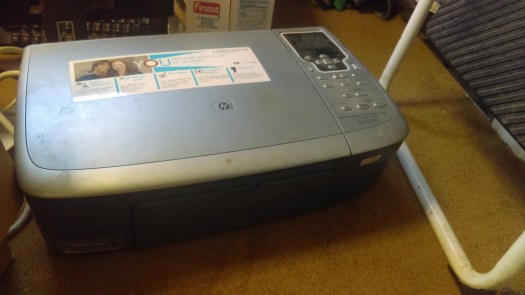
This is one of several pieces of e-waste that I have in my house. This ancient printer is one such piece of e-waste and is harder to get rid of than some readers might think.