Coronavirus Update From New York City: June 4, 2020

The news in recent days has focused more on the unjust police killing of George Floyd (and its aftermath) than the coronavirus, and understandably so. That being said, as there is an ongoing coronavirus situation in my city and state, I would like to provide my usual weekly update.

On all fronts, everyone in my family is doing physically okay. All of us remain healthy, though allergies definitely continue to be an issue! The other day I had a coughing fit because of those allergies while I was outside, and I was legitimately worried that someone would confront me for the coughing fit! Thankfully, that didn’t happen.

While I already mentioned above that I’m not going to go too much into the situation with the anti-racism protests in New York, it’s worth my mentioning that I don’t live near the center of it all, so the abnormally heavy police presence that some of you may be hearing about from New York doesn’t apply to me. It applies to my friends who live in or near areas where these protests are happening, though.

New York City seems to be continuing to go in the right direction with regards to the coronavirus. We have not started our reopening process yet, but Governor Cuomo has said that if we continue heading in the right direction in New York City, we might be able to begin the reopening process on June 8th. Fingers crossed. Hopefully by this time next week, I will be talking about a New York City that’s beginning a safe reopening process.

People may be wondering how the protests over systemic racism (which I unequivocally support, not that the protests need my support) may affect COVID rates. Based on what I’ve seen on television, it looks like the overwhelming majority of protesters are wearing face masks, which are key in trying to keep the coronavirus from transmitting to others (even if you have it yourself). Since so many of the protesters are wearing face masks, I am not as worried as some about how the protests may affect coronavirus transmission. We’ll see if my lack of worry holds true.

I hope others are doing okay!
On the Policing of People of Color and the Death of George Floyd

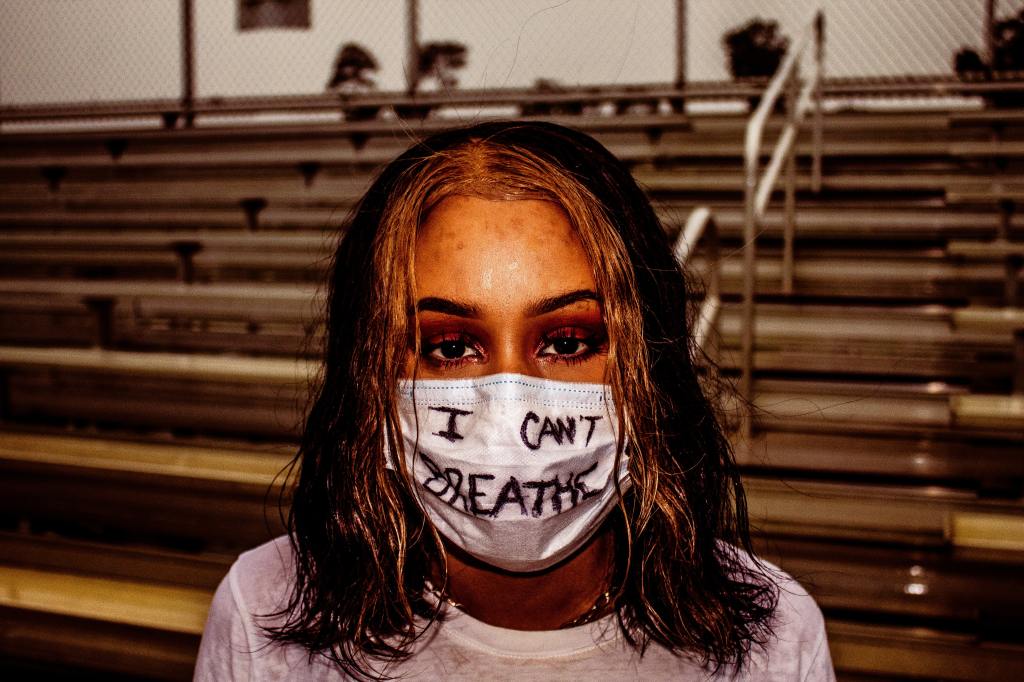
Someone with a face mask that says “I can’t breathe.” “I can’t breathe” was said by Eric Garner as he was killed by police in New York several years ago, and it was also said by George Floyd recently as he was killed by Minneapolis police.

On Monday, May 25th, George Floyd, an unarmed person of color, was killed by a Minneapolis, Minnesota police officer who knelt on Floyd’s neck for several minutes, even after he was handcuffed.

This was an extremely disturbing story—so disturbing that I am choosing not to show yet again to people the image of this officer kneeling on Floyd. It was yet another example of police using excessive force on an unarmed person of color.

And yet, at times over the past week, I have struggled to figure out what to say about the killing of Floyd. After all, I am white, I am conscious that I have a lot of privilege that comes with being white, and the last thing I want to do is drown out the voices of people of color advocating for justice. But then, I found that I did feel compelled to say some things, so here you go…

Growing up in New York City with all the friends of color my brother and I had, it was clear that there was a major disparity between the way the two of us were policed and the way our friends of color were policed. The two of us never got stopped, searched, or frisked by the police, but our friends of color frequently experienced that—so frequently that people would call it “walking while brown.” The stories of frequent stops from our friends also matched statistics for stop-and-frisk in New York City—blacks and Hispanics at one point made up only half of the population, but 85% of the stops.[1] I can go on and on with the statistics and the stories related to stop-and-frisk, but to read more, I encourage you to read my blog post about the institutional racism in the way I was policed. So when people suggest that racism does not exist with policing, I have personal experiences that show otherwise. Racism exists in policing.

What I didn’t do as much in that post on institutional racism and policing was show how said racism goes well beyond stop-and-frisk; after all, I was focused on my own experiences of privilege in that post. So, while an entire book could probably be written on racial disparities in the way people are policed (or are generally handled in the criminal justice system), here are some lowlights:

  • Blacks are 3.64 times as likely to get arrested for marijuana use as whites, even though usage rates are comparable. In some cases, those rates have become worse, even with the current push towards legalization in some parts of the country.[2]
  • Staying on the topic of drugs, even though usage of illegal drugs is comparable between blacks and whites, blacks are five times as likely as whites to go to prison for illegal drug possession.[3]
  • On average, police seem to require less suspicion of black and Hispanic drivers before they are pulled over than white drivers.[4] This statistic is particularly relevant to the current discourse on policing and people of color, as a few years ago a traffic stop of Philando Castile, a person of color, led to his being killed by a police officer.
  • Innocent blacks are about seven times more likely to be convicted for a murder they didn’t commit than whites.[5]
  • Unarmed blacks are about 3.49 times as likely to get shot by the police as unarmed whites.[6]

“How does this all relate to the killing of George Floyd?” you may ask. Floyd’s killing shows that the police murder of Mr. Floyd does not exist in a bubble. Far from it. To the contrary, this killing is a microcosm of a larger problem: there are vast racial disparities in the way people are policed in the United States of America.


[1] https://www.forbes.com/sites/jasonoberholtzer/2012/07/17/stop-and-frisk-by-the-numbers/#43c323106703

[2] https://www.forbes.com/sites/tomangell/2020/04/20/on-420-aclu-highlights-racist-marijuana-enforcement-in-new-report/#229dc03f7487

[3] http://www.law.umich.edu/special/exoneration/Documents/Race_and_Wrongful_Convictions.pdf

[4] https://openpolicing.stanford.edu/findings/

[5] http://www.law.umich.edu/special/exoneration/Documents/Race_and_Wrongful_Convictions.pdf

[6] https://www.ncbi.nlm.nih.gov/pmc/articles/PMC4634878/

Coronavirus Update From New York City: May 27, 2020

I hope that everybody had a good Memorial Day weekend!

Everyone in my immediate family remains healthy. That being said, I’m glad that I’m not spending tons of time in public, because at times I get allergies that can cause me to have coughing fits (and coughing fits that can result in people being concerned about me). Employment continues to not be an issue for me, though I am knowing more and more people who are having issues with being furloughed or unemployed.

The situation is continuing to move in the right direction in New York City and New York State.

At the state level, nine of the state’s ten regions are beginning the process of reopening their economies, though I must emphasize that it is a process. There are four phases involved in reopening a region in New York, and these regions are only beginning to enter the first phase. Nevertheless, it is a positive step that we’re seemingly having the pandemic enough under control that we can begin to reopen things. It is also a positive step that daily deaths from COVID-19 in New York State has dropped below 100 on a regular basis.

The only region that has not begun that process of reopening is…New York City. We don’t yet have the adequate contact tracing, and we don’t yet have a high enough availability of hospital beds to reopen safely; for those two reasons, we are not able to reopen yet. That being said, our numbers are trending in the right direction even in New York City, and I am hopeful that in the next couple of weeks, New York City will also begin the process of a measured and safe reopening.

With many places reopening (including most of New York State), I think it is worth discussing what the “endgame” is for these weekly COVID update posts. My plan is that I will continue doing these update posts until it is clear that New York City is opening up safely (which, to me, means that the situation in New York City looks okay for a month to six weeks after beginning to reopen). I think it is important to document for curious readers how the reopening process is going, and whether the situation continues to improve or not where I am. If, after four-six weeks, the reopening appears to be going safely, then I will wind down these weekly update posts. However, if the much-feared second wave of the virus comes, these weekly updates would return at a later point. And, of course, if the reopening doesn’t go well, then I will continue these updates, so that my readers know how things are going in New York.

I hope that others are doing well! I’m hearing mixed reviews of how reopening is going in various states and regions.

P.S. For those of you into numbers, I encourage you to visit New York’s Regional Monitoring Dashboard. This dashboard allows you to see how all the regions of New York State (New York City being one of them) is performing with several critical metrics that need to be met before reopening begins: decline in hospitalizations, decline in hospital deaths, new hospitalizations, hospital bed availability, ICU bed availability, testing capacity, and contact tracing capacity.

P.P.S. I actually intended to publish this tomorrow. I thought I had this scheduled for tomorrow at 6, but instead I published this today at 6. Oh well. Tomorrow evening is busy for me anyway, so perhaps it’s better that I have my update today. Future update posts will be on Thursdays, starting next Thursday.

Coronavirus Update From New York City: May 21, 2020

It is hard to believe that we are already approaching Memorial Day! When this whole stay-at-home thing started, it was still winter; now we’re approaching summer!

Everyone in my family continues to remain physically healthy, thankfully. I also continue to have employment, even as there are millions upon millions filing unemployment claims in the United States. Emotionally, while it’s not always easy, it definitely helps that NASCAR, which is one of my family’s favorite sports, is back on television–when the races come on, they are a 3-5 hour reprieve from all the COVID stuff going on in my city, state, country, and world. I just hope that the races can continue to be done safely, and that nobody gets sick! I’m optimistic, though, because it seems like the sport is taking a lot of precautions.

As for statewide indicators in New York, things for the most part continue to trend in the right direction. Governor Cuomo said at his press conference today that hospitalizations are down and that there were 105 new deaths reported in our state today. While that is still 105 too many, we definitely continue to trend in the right direction statewide. As for New York City specifically, though, while things are trending in the right direction, it still looks like it may be a bit before we start to reopen, as we’ve only met four of the seven indicators needed for beginning to reopen (contact tracing, as well as availability of total hospital beds and ICU beds, are the things we don’t adequately have yet in New York).

My family tends to not be big into travelling on Memorial Day weekend, so I guess I’m not as affected by some of the restrictions as others may be. The lack of an Indianapolis 500 (watching that race is a yearly thing in my household) is going to feel weird though. Yeah, my auto racing fandoms are showing in this post.

I hope my readers are doing well!

Poor Women, Wealthy Men, and the New School Sexual Assault Regulations

Because of the media’s focus on the coronavirus, one story that has gone somewhat (but not completely) under the radar is the changes that United States Education Secretary Betsy DeVos put into place for regulations that replaced Obama-era guidelines on how sexual assault accusations are dealt with at schools.

According to National Public Radio, which did a rather thorough piece on these changes, “Among the most significant changes are new regulations aimed at beefing up protections for accused college students, by mandating live hearings by adjudicators who are neither the Title IX coordinator nor the investigator, and real-time cross examination of each student by the other student’s lawyer or representative.”[1] I want to zero in on the change I quoted here, because this is a regulation that will likely end up harming poor women the most and helping wealthy men the most.

In making this argument, it’s worth saying that the real-time cross examination is something that advocates worry will open up wounds for survivors of the assaults under investigation. While yes, there are absolutely male survivors of sexual assault, as well as survivors who do not fall within the male-female gender binary,[2] this is a change that disproportionately hurts women in general, as women of school age are much more likely to be survivors of sexual violence than men of school age.[3] Therefore, when we’re talking about cross examination opening up wounds for survivors, we are most of the time talking about opening up wounds for female survivors of sexual assault. This change will harm women in general.

However, this change will harm poor women the most. This real-time cross examination by the other student’s lawyer or representative, in effect, results in a double whammy for poor people who are survivors: emotional wounds opened up by cross examination by the defendant, and then an inability to spend the money to hire a good lawyer or representative to answer in any effective way to the cross examination. As most survivors are women, this double whammy for poor people who are survivors will predominantly affect poor women. I just hope that there are lawyers/representatives out there willing to potentially do some pro bono work here because otherwise, I don’t see how poor women who are survivors stand much of a shot at getting justice in sexual assault cases under the DeVos guidelines.

On the other hand, these new regulations will likely end up helping wealthy men because: a) most perpetrators are men and b) the male perpetrators who come from wealthy families will be able to spend on the best lawyer/representative money can buy in order to fend off any accusations. Unless the survivor comes from a situation of economic wealth and can have the ability to hire good lawyers, the side of the wealthy male perpetrator is well positioned to win the legal case.

As to the results of these DeVos changes, I do tend to agree with advocates that this will likely have a chilling effect on reporting in general. However, I fear it will have a particularly chilling effect on reporting from poor women survivors of sexual assault. While some people may take pride in being right on something, this is a case where I really hope I am wrong.

Please note that because of Memorial Day, I will not publish a post next Monday.


[1] https://www.npr.org/2020/05/06/851733630/federal-rules-give-more-protection-to-students-accused-of-sexual-assault

[2] And if you’re a male survivor of assault or a survivor who doesn’t fit within the male-female gender binary, your story is no less valid because you are not a woman.

[3] https://www.rainn.org/statistics/victims-sexual-violence